


 DOI : 10.17577/
The rise of AI lately has revolutionized the way we perform various tasks. AI-driven task completion has certainly made our everyday life easier. While there are plenty of tasks we can do with the help of advanced technology, AI-driven writing has led to varied opinions. It surely makes it easier for many to draft impeccable documents without spending too much time and effort, but over-reliance on it is also causing problems.
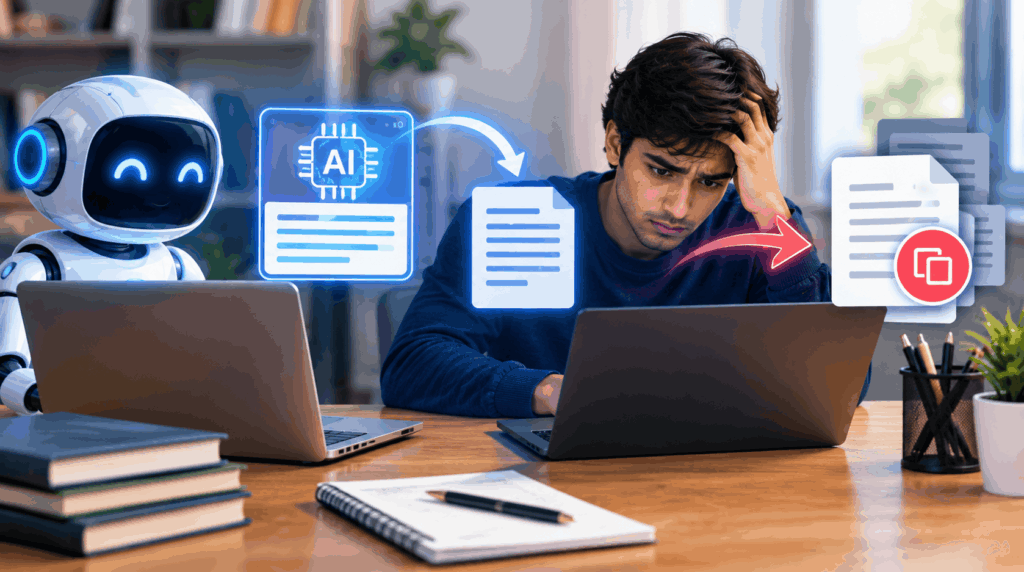
Especially when we see students, professionals and content creators using AI excessively. They are relying on it for the generation of blog posts, facilitation in the creation of academic essays and whatnot. However, is it a wise approach? Nobody can deny the speed, convenience and creativity AI tools offer. Yet, a serious risk lies beneath this technology-driven convenience, which is plagiarism because of excessive reliance on AI.
This article defines plagiarism in the AI-driven digital era, continuously fading line between originality and duplication, ever-growing importance of plagiarism detection and strategies to balance AI assistance with human oversight.
Read on to learn more.
Plagiarism in the Age of AI
The concept of plagiarism in the age of AI is more than word-for-word copying of text without proper attribution, as it was previously. Plagiarism is no longer confined to simple copying and pasting because it takes on new dimensions in the modern AI-driven digital era. Now, it is found in the form of:
- Direct Duplication occurring because of reiteration of existing information retrieved from training data modules.
- Unintentional Overlaps existing in AI-generated text that closely resemble already published material.
- Idea-Based Plagiarism that makes your work a blend of borrowed ideas because of stripped originality occurring due to over-reliance on AI.
In essence, plagiarism today is the failure to demonstrate authentic thoughts, creativity and originality in ideas.
Why Excessive AI Use is Behind Growing Plagiarism?
Despite significant advancements in AI-driven tools available for crafting content, you can’t rule out the likelihood of plagiarism sneaking into AI-generated text. Various reasons contribute to this possibility.
A few of them are:
Training of AI Tools on Existing Information
We all know that AI took inspiration from humans, which is why it is termed “Artificial Intelligence”. Advanced writing tools were also trained on already existing vast datasets of books, articles and web-based content to help AI understand how humans write and structure content. When you prompt these tools, they may accidentally reiterate exact phrases from those datasets.
Reduced Human Oversight
The biggest mistake made by modern-day users is assuming that a perfectly engineered prompt can help them instruct AI tools to craft entirely unique content. However, it is a false approach. Your unique perspective, voice and creativity are sidelined when you rely too heavily on AI. Resultantly, content appears highly generic, comes loaded with redundant phrasing and features unnoticed or uncredited overlaps with existing sources.
Inability of AI to Recognize Originality
You may find it surprising, but AI isn’t familiar with the concept of plagiarism. When it is prompted to draft text on a particular topic, it simply generates the output, which is purely based on probability. AI tools don’t consider ethics, which means plagiarism risks skyrocket in the absence of human oversight.
The Echo Chamber Effect
You may find it tricky to understand the reason, but it is quite simple. Consider multiple students taking inspiration from the same source to draft an essay. All of them will end up submitting almost similar work, featuring the same arguments, phrasing and structure.
The same is applicable to AI. Multiple writers leveraging the same AI prompts will get similar outputs. Resultantly, you will see the web and academia flooded with nearly identical write-ups. This phenomenon will dilute originality and fuel plagiarism.
Tips to Use AI without Plagiarizing Work
AI is here to make our lives easier. Giving up the idea of using it is not a wise approach. The need of the hour is to adopt a balanced approach that prevents us from excessively relying on AI.
Here are some tips to make it possible:
Consider AI a Drafting Assistant
Stop using AI as a substitute writer that will do the heavy lifting for you. Instead, focus on using it as a brainstorming partner that helps you retrieve information on various topics easily. You can also leverage it to draft outlines or get phrasing recommendations.
However, always reiterate AI-generated output in your own words that demonstrate your writing style and voice that is entirely exclusive to you.
Infuse Human Insight into Your Work
Instead of prompting AI tools, generating output and pasting it straight into your work as if it is totally original, focus on adding human insight to the AI-generated text. Understand the requirements of the topic you are writing on and figure out how you can make it valuable for the target audience.
Doing so will make it easier for you to come up with original work in the form of personal experiences, cultural context and unique opinions that are non-replicable by AI. Add these elements to boost the originality of your writing.
Run Originality Checks
Excessive use of AI also invites plagiarism issues. As we all know, AI models are trained on existing data; they may poorly paraphrase published content, which can lead to plagiarism allegations.
So, to prevent this, before publishing or submitting your work, you must use a reliable plagiarism checker to verify its originality. This tool can prove to be a handy resource in this scenario, as besides helping you find exact matches, it can also detect paraphrased content, which is usually the case with AI-generated content.
Emphasize Proper Citations
If you see AI-generated text coming with facts or quotes that are attributed to a particular source, verify them first by checking the referred sources. This strategy will help you avoid fabrication of information or hallucination of facts that is natural to AI, because it is still not capable enough to ensure accurate references every time.
Additionally, this practice will help you avoid source laundering, which is also considered plagiarism in the modern era. Once you are sure about the accuracy of facts or quotes, cite sources properly to avoid plagiarism allegations.
Limit Reliance on AI
You may have heard the phrase “balance is the key” many times. The same is applicable to the usage of AI, especially in the context of writing content.
Over-reliance on AI multiplies the risk of duplication and contributes to dilution of your authentic voice in your work. So, it is better to use it sparingly and that too as a brainstorming partner.
The Wrap
AI is undoubtedly a powerful ally, which plays a key part in making our everyday tasks quick and trouble-free. However, using it excessively to write content can make it a liability. You may not intend to plagiarize your work but over-reliance on AI may lead to unintentional overlaps. Using AI wisely with proper oversight is essential to prevent plagiarism from sneaking into your writing. Treat AI tools as your drafting assistants instead of substitute writers. You can work wonders by crafting authentic and impactful content with a balanced combination of AI’s efficiency and human creativity!

