


 DOI : 10.17577/
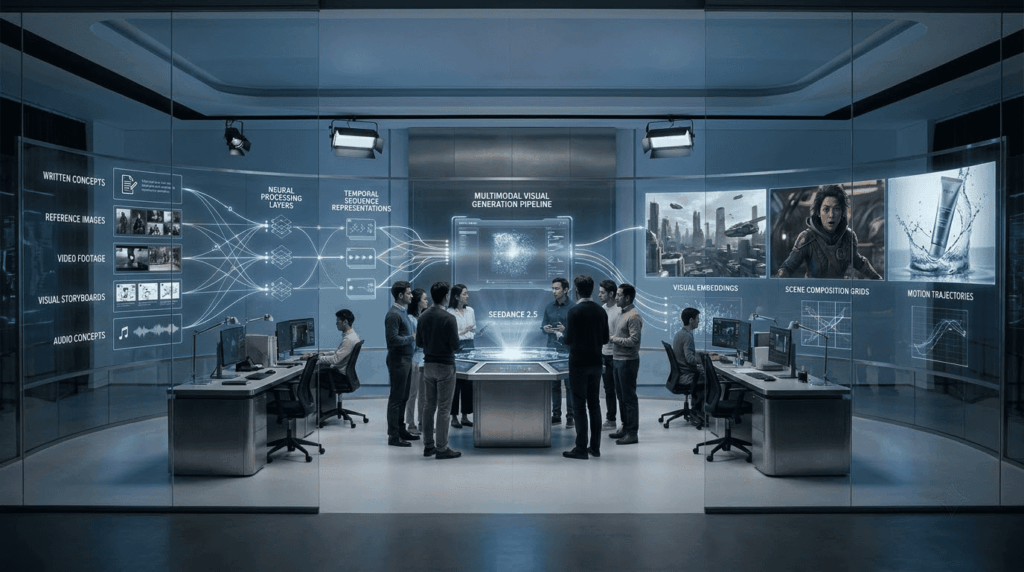
Multimodal visual generation is becoming an important area of artificial intelligence research as modern systems move beyond simple text to image generation. Instead of treating text, images, motion, references and audio as completely separate inputs, newer creative systems are exploring how different forms of information can work together to produce richer visual outputs.
Seedance 2.5 represents this broader direction toward multimodal visual generation. Higgsfield places this technology within a wider creative workflow, allowing users to explore prompts, references, sequences and visual storytelling while experimenting with different creative directions.
For researchers, developers, designers and technology professionals, this development raises several questions. How does multimodal generation differ from traditional image generation? What types of inputs can influence a visual result? Where can these systems be applied? What challenges remain around consistency, controllability, accuracy and responsible use?
This technical overview examines these questions while considering the broader role of Seedance 2.5 in modern AI based visual generation.
Abstract
Multimodal generative systems are expanding the capabilities of artificial intelligence by combining multiple forms of information within visual creation workflows. Seedance 2.5 represents an emerging approach in this area, enabling creators to work with richer combinations of instructions and visual references. This article examines the concept of multimodal visual generation, its workflow, potential applications, technical considerations, advantages, limitations, and future research directions. The discussion also considers how platforms such as Higgsfield can provide a broader environment for experimenting with generative visual workflows.
Introduction
Traditional computer generated imagery often depends on manually designed assets, predefined environments, and carefully controlled production pipelines. Generative artificial intelligence introduces a different approach by allowing systems to create visual material from high level instructions.
Early generative systems commonly focused on a single input output relationship. A text prompt could produce an image, for example. As generative technologies developed, users began expecting greater control over the output.
This has encouraged research into multimodal systems that can work with different forms of information simultaneously.
Seedance 2.5 fits within this broader development. Rather than considering visual generation as a single isolated operation, it can be viewed as part of a workflow in which textual instructions, visual references, sequences and other creative information influence the intended result.
The significance of this approach is not simply the ability to produce attractive visuals. The larger research question is how generative systems can provide greater control, consistency, flexibility and contextual understanding.
Understanding Multimodal Visual Generation
Multimodal visual generation refers to systems that can use more than one type of input or information source during the creative process.
Possible modalities include:
- Text
- Images
- Video
- Audio
- Structured instructions
- Reference material
- Visual compositions
In a conventional text to image workflow, the primary instruction is written language.
A multimodal workflow can provide additional context through an image or another reference. This gives the system more information about the desired appearance, composition, subject, or creative direction.
Seedance 2.5 can be discussed within this broader category because modern visual generation workflows increasingly emphasize relationships between different types of creative information.
This approach is particularly relevant to applications where a simple text description is insufficient to communicate the complete visual requirement.
How Does a Multimodal Generation Workflow Work?
A simplified multimodal workflow can be represented as:
Input → Interpretation → Generation → Evaluation → Refinement → Final Output
Input
The process begins with one or more forms of creative information.
A user may provide a written description, reference image, visual style, or other relevant instruction.
Interpretation
The generative system processes the available information and attempts to establish relationships between the different inputs.
Generation
The system produces a visual output based on the interpreted instructions.
Evaluation
The generated result is reviewed against the original objective.
Refinement
If the output does not satisfy the intended requirements, the user can modify the instructions or references and generate another version.
This iterative process is important because generative systems do not necessarily produce the desired result on the first attempt.
What Makes Seedance 2.5 Relevant to Multimodal Workflows?
The significance of Seedance 2.5 lies in the broader movement toward more flexible generative workflows. A visual idea is rarely communicated through one piece of information alone. A filmmaker may have a written concept and reference frames. A designer may have a moodboard. A marketer may have a product image and campaign instructions. An educator may have diagrams and written explanations.
Multimodal systems can potentially use these different forms of context to support more specific visual development. This creates an important distinction between generation and controlled generation.
The objective is not merely to produce something visually appealing. It is to produce something that is closer to a particular creative requirement.
Role of Reference Based Generation
Reference based generation is an important part of modern visual workflows.
Instead of describing every visual characteristic through text, a user can provide an existing visual reference that communicates aspects such as:
- Composition
- Character appearance
- Environment
- Lighting
- Colour relationships
- Visual style
Higgsfield supports this type of broader creative experimentation by allowing users to work with visual concepts and references as part of an integrated creative workflow.
For example, a creative team developing a campaign may have an established visual identity. Rather than describing that identity entirely through words, reference material can provide additional context during concept development.
The reference does not necessarily determine the final result. It can act as guidance for the creative direction.
Visual Consistency Across Multiple Outputs
Consistency is one of the major challenges in generative visual systems.
Generating one attractive image is different from generating multiple assets that appear to belong to the same project.
A recurring character, environment, product, or visual identity may need to remain recognizable across several outputs.
Seedance 2.5 can be considered within this wider research challenge because multimodal generation increasingly requires systems to maintain relationships between visual elements across different outputs.
Higgsfield AI creative suits also address this broader creative requirement through tools and workflows designed around visual consistency and reference based creation.
For professional applications, consistency can be just as important as image quality.
From Individual Images to Visual Sequences
Another important development is the movement from isolated images toward connected visual sequences.
A single image communicates one moment. A sequence can communicate:
- Progression
- Movement
- Cause and effect
- Narrative
- Transformation
- Demonstration
Seedance 2.5 reflects this broader transition toward generative workflows where visual ideas can be developed beyond a single static frame.
This can be particularly relevant to advertising, filmmaking, education, product demonstrations and digital storytelling.
The challenge is maintaining continuity while introducing meaningful changes between individual shots.
Potential Applications of Multimodal Visual Generation
The applications of Seedance 2.5 and similar multimodal systems can extend across multiple fields.
Advertising
Marketing teams can explore campaign concepts, visual treatments, product environments and different creative directions.
Film and Previsualization
Production teams can experiment with environments, compositions, scenes and sequences before committing to physical production.
Education
Visual generation can help illustrate complex processes, historical environments, scientific concepts and technical subjects.
Product Visualization
Businesses can explore how products might appear in different environments or campaign contexts.
Social Media
Content teams can develop visual concepts adapted to different platforms and audiences.
Storytelling
Creators can experiment with characters, environments, and sequences while developing early versions of a story.
These applications demonstrate why multimodal generation is becoming relevant beyond entertainment.
How Can Higgsfield Support a Multimodal Creative Workflow?
It provides a broader creative environment in which users can experiment with different AI powered visual workflows. For example, a creator may begin with a written concept, introduce reference material, explore an initial visual direction, refine the result, and then develop additional creative assets. This workflow can reduce the separation between different stages of visual development.
Instead of moving immediately from an idea to final production, creators can use intermediate generations to test possibilities.
This can be particularly valuable for:
- Creative teams
- Designers
- Marketers
- Filmmakers
- Publishers
- Independent creators
- Educators
The platform becomes most useful when it supports the thinking process around the visual, rather than simply producing an output.
Technical Considerations
Multimodal visual generation involves several technical challenges.
Context Understanding
The system must interpret relationships between different input types.
Visual Consistency
Generated elements should remain coherent across multiple outputs.
Temporal Consistency
For sequential content, subjects and environments should remain stable as the scene develops.
Instruction Following
The generated result should reflect the intended instructions rather than producing an unrelated interpretation.
Resolution and Detail
Professional applications often require sufficiently detailed outputs for further editing and distribution.
Computational Requirements
Generative models can require substantial computational resources, particularly for complex visual generation.
These considerations demonstrate that multimodal generation is not simply an artistic problem. It is also a computational and engineering challenge.
Prompt Design and Input Quality
The quality of the input can significantly influence the usefulness of a generated result.
A vague instruction may leave too many creative decisions open.
A more structured instruction can specify:
- Subject
- Environment
- Composition
- Lighting
- Camera perspective
- Mood
- Style
- Intended use
For Seedance 2.5, this principle is particularly relevant when users are attempting to achieve a specific creative result.
However, adding more words does not automatically guarantee a better output. The instructions should provide useful information rather than unnecessary complexity.
Iterative Refinement
Generative workflows are naturally iterative.
A typical process may look like:
Concept → First Generation → Review → Adjustment → Second Generation → Refinement → Final Direction
This approach allows users to identify what is working and what needs improvement.
It can support this type of experimentation by allowing creators to move between different stages of visual development within a broader creative workflow.
The iterative process also changes the role of the creator.
Instead of manually producing every visual element, the creator increasingly becomes responsible for directing, evaluating, selecting, and refining generated possibilities.
Comparison With Traditional Visual Production
Multimodal generation does not necessarily replace traditional production.
| Aspect | Traditional Workflow | Multimodal Generative Workflow |
| Concept development | Manual | AI assisted exploration |
| Reference use | Moodboards and examples | Integrated visual references |
| Iteration | Often time consuming | Rapid experimentation |
| Final control | High | Requires human refinement |
| Physical production | Often required | May be reduced for some concepts |
| Creative direction | Human led | Human led with AI assistance |
Traditional production remains valuable when physical realism, exact product representation, performance, location, or detailed artistic control is required.
Generative systems provide another method for exploring ideas.
Limitations and Challenges
Despite rapid development, multimodal generation still presents important limitations.
Consistency
Maintaining the same subject across multiple outputs can be difficult.
Accuracy
Generated visuals may contain incorrect details.
Control
The system may interpret an instruction differently from what the user intended.
Reproducibility
Repeated generations may not produce exactly the same result.
Human Judgment
Generated content still requires evaluation by someone who understands the project’s objective.
Ethical Considerations
Creators must consider intellectual property, consent, representation and responsible use when working with generative systems.
These challenges are important areas for future research.
Role of Human Creativity
The development of multimodal AI does not eliminate the need for human creative direction.
A generative model can produce visual possibilities, but humans still determine:
- What should be communicated
- Who the audience is
- Which concept is appropriate
- Whether the output is accurate
- Whether it fits the brand
- How the result should be refined
Seedance 2.5 should therefore be viewed as part of a broader human AI workflow rather than an autonomous replacement for creative professionals.
The quality of the final result depends not only on the generation system but also on the quality of the creative direction surrounding it.
Future Research Directions
Future research in multimodal visual generation may focus on improving:
Better Cross Modal Understanding
Systems may become better at understanding relationships between text, images, audio and video.
Improved Consistency
Future models may provide stronger control over characters, objects, environments and visual identities.
Greater User Control
Creators may gain more precise control over composition, movement, style and narrative progression.
More Efficient Generation
Improvements in model architecture and hardware could make complex generation faster and more accessible.
Better Evaluation
Researchers may develop improved methods for measuring visual quality, factual accuracy, consistency, and instruction following.
These developments could expand the practical applications of Seedance 2.5 style multimodal generation.
Practical Workflow for Creators
A practical workflow can be organized into five stages:
Stage 1: Define the Objective
Determine what the visual needs to communicate.
Stage 2: Collect References
Gather relevant images, examples, or other contextual material.
Stage 3: Generate Initial Concepts
Use Seedance 2.5 within an appropriate creative workflow to explore possible directions.
Stage 4: Evaluate and Refine
Compare outputs against the original objective and adjust the instructions or references.
Stage 5: Prepare the Final Asset
Apply professional editing, quality control, branding and formatting before publication or production.
Higgsfield can support multiple stages of this process by providing a broader environment for experimentation and refinement.
Conclusion
Multimodal visual generation represents an important evolution in generative artificial intelligence. Instead of relying on a single form of input, modern workflows increasingly explore how text, images, references, motion, and other creative information can work together. Seedance 2.5 can be considered within this broader movement toward more flexible visual generation systems. Its relevance is not simply the ability to generate visual content, but the possibility of giving creators more ways to communicate and refine creative intent.
At the same time, technical challenges remain around consistency, accuracy, controllability, computational requirements and responsible use. Higgsfield demonstrates how these technologies can be placed within a wider creative environment where users can experiment, refine and connect different stages of visual development.
Ultimately, multimodal generation is likely to be most valuable when it works alongside human expertise. The technology can expand the range of possibilities, while creators remain responsible for deciding which possibilities are meaningful, accurate and appropriate for the final application.

