


 DOI : 10.17577/
Legacy systems resist retirement not because engineers are sentimental but because they are operationally load-bearing. Decades of embedded business logic, regulatory compliance routines, and undocumented workarounds make a “big bang” replacement not merely risky but frequently catastrophic. The alternative—API-led integration—offers a path that preserves continuity while steadily relocating capabilities to modern cloud infrastructure. The core idea is to insert a controlled abstraction layer between consumers and backend systems, then migrate functionality incrementally behind that layer. Regulated industries demonstrate this challenge at its most acute: in insurance, for instance, architects who need to modernize a legacy insurance system must account for policy processing uptime, regulatory audit trails, and partner integration contracts all simultaneously. The technical and organizational principles that govern this problem are broadly applicable across any sector where mission-critical systems cannot tolerate interruption.
The Role of an API Gateway When Migrating
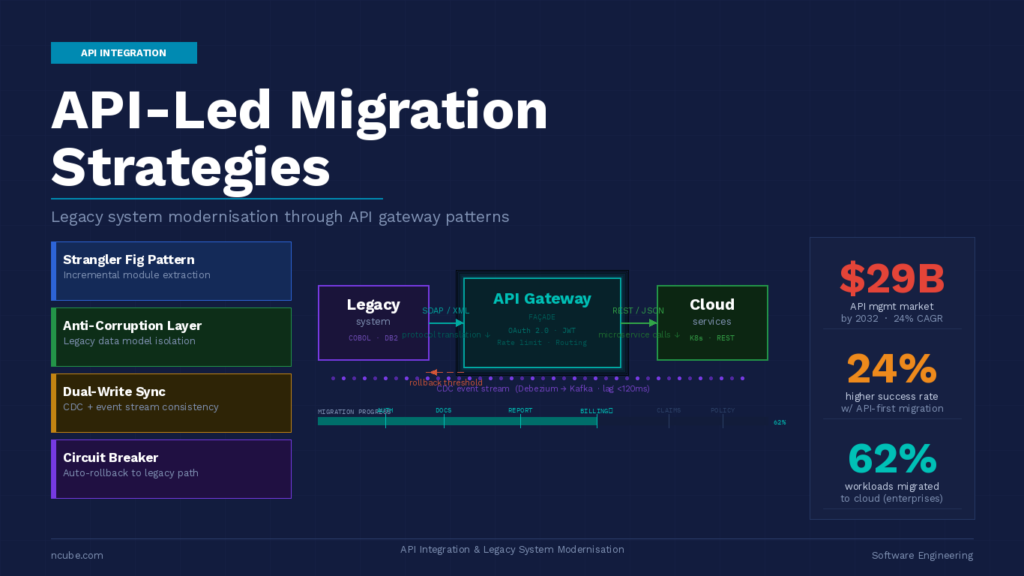
Think of an API gateway as more than just a fancy router. In migration, it becomes the traffic cop. It keeps users and apps talking to the same interface, even as you slowly swap old services for new cloud ones behind the curtain. That’s what makes a slow, safe migration possible — the “contract” that users depend on never changes.
This gateway takes over as the single entry point. Every request — no matter which app or user — goes through it first. It checks each request, then decides: send it to legacy, or to the shiny new service? The rules aren’t simple yes-or-no. You can steer traffic by percentage, user, feature flag, or any other rule you need, so you can quietly test new services with real traffic before going all in.
Three main things matter for the gateway during migration:
- Request transformation: Legacy platforms speak in weird languages — maybe SOAP, flat files, or proprietary formats nobody remembers. The gateway translates all that to modern, standard APIs (like REST or gRPC), so your new cloud services don’t have to wrestle with ancient formats.
- Anti-corruption: Don’t let new microservices get tangled up in old database schemas. If you just wrap an old database with an API, you’re building a “distributed monolith” — new services jammed with old limitations. The gateway and a strong translation layer keep the new world clean.
- Observability: Before you move anything, start measuring. The gateway should track things like latency, error rates, and payload shapes from the legacy system. Those baselines become your yardstick for the new services.
The Strangler Fig Pattern: How It Works
The “strangler fig” pattern gets lots of love because it works — at least, when you’re careful. You replace legacy features one chunk at a time, always keeping the business running. An API gateway manages all traffic during this, reducing risk and avoiding downtime.
You repeat a simple process: proxy, extract, test, then fully redirect. Each cycle picks a bounded scope — something self-contained, like user logins or reports. Good target selection is crucial. You want chunks with high business value, that don’t tangle with everything else in the system. Domain-Driven Design can help map out where those logical boundaries are.
Picking Where to Start
It’s tempting to grab the “easiest” component first. Honestly, what matters more is how much it’s connected to the old system — how many tables it touches, and who uses it. You want pieces with small database footprints and limited dependencies. Read-only components, like reports and analytics, are usually solid starting points. They’re easy to watch, unlikely to break anything critical, and often relieve a surprising amount of load — delivering a quick payoff.
Keeping Data in Sync When Both Systems Run at Once
During a migration, you’ll usually have both old and new systems talking to the same customers at the same time. This creates a headache — how do you keep data in sync across two databases? There are two main strategies:
- Dual-write with reconciliation: Every new service writes to both old and new databases. An extra process checks for mismatches and fixes them. This is labor-intensive but gives you a rollback path if things get messy.
- Event-driven sync: Use Change Data Capture (CDC) to stream every change from the old database into a message queue. New cloud services watch those queues to stay current. This keeps the systems loosely coupled, which is nice, but legacy systems often aren’t set up for CDC, so you might need add-ons like Debezium.
None of these are perfect. So, you have to decide — up front — what consistency guarantees you’re offering, and document them in the API for everyone to see.
Regulatory Requirements and API-Led Integration
In places like insurance or banking, wrapping legacy logic in APIs helps you add new features and keep running without a giant rebuild. It keeps risk low and business open. But regulated industries come with special baggage.
Audit trails are one big issue. Regulators need to see every transaction, unchanged and tamper-proof, no matter how the system evolves. Logging every API request and response at the gateway — stamped and stored where nobody can mess with them — solves this, often without touching the old system.
Authorization is another issue. Old systems rarely support new standards like OAuth 2.0. The API gateway can enforce strict permissions at the entry point while old sessions keep running in the backend. Sure, it’s a compromise, but it gets the migration unstuck.
A side note: API management as a market is exploding. Analysts expect it to grow from $6.48 billion to $29.25 billion by 2032. Not because it’s trendy, but because companies realize this layer isn’t just a stepping stone — they need it to run their business, permanently.
Failure Modes to Anticipate
A few patterns cause migrations to fail:
- Gateway bottlenecks: As more traffic shifts, the gateway carries more weight. Teams who treat it as an afterthought soon find themselves with a single point of failure. You need to scale it out (horizontally), design error handling, and add rate limiting early — bolting it on later is a disaster.
- Stopping halfway: Sometimes, after a few easy wins, businesses think, “good enough.” What’s left are usually the gnarliest, riskiest, most interconnected pieces. If you quit early, you stick yourself with two architectures — the hardest parts of both, and none of the benefits.
- Schema drift: If the legacy database schema changes mid-migration and the translation layer doesn’t keep up, you end up with silent, long-term data corruption. The anti-corruption layer needs to stay updated — think of it as real code, not just a one-time setup.
Wrap-Up
API-led integration gives you the structure to modernize — one step at a time. The API gateway steers traffic, upholds contracts, and lets you measure before you leap. The strangler fig pattern brings an operational rhythm: move one domain at a time, always delivering working code, not a risky “big bang.”
Getting the tech right is challenging, but the real test is sticking with it. Don’t stop after the obvious wins. If you do, you’ll pay the price of running two systems forever — with all the hassle and none of the certainty. Aim for full migration. API-led integration makes that safe, measurable, and practical.

