


 DOI : 10.17577/
Editor’s note: The family described below is a composite case based on common experiences reported by international students and parents. The dialogue is illustrative rather than a verbatim record of a real interview.
When “Lina” moved to the United States with her son, she believed that getting him into university would be the hardest part. She soon discovered that remaining there could be even more difficult.
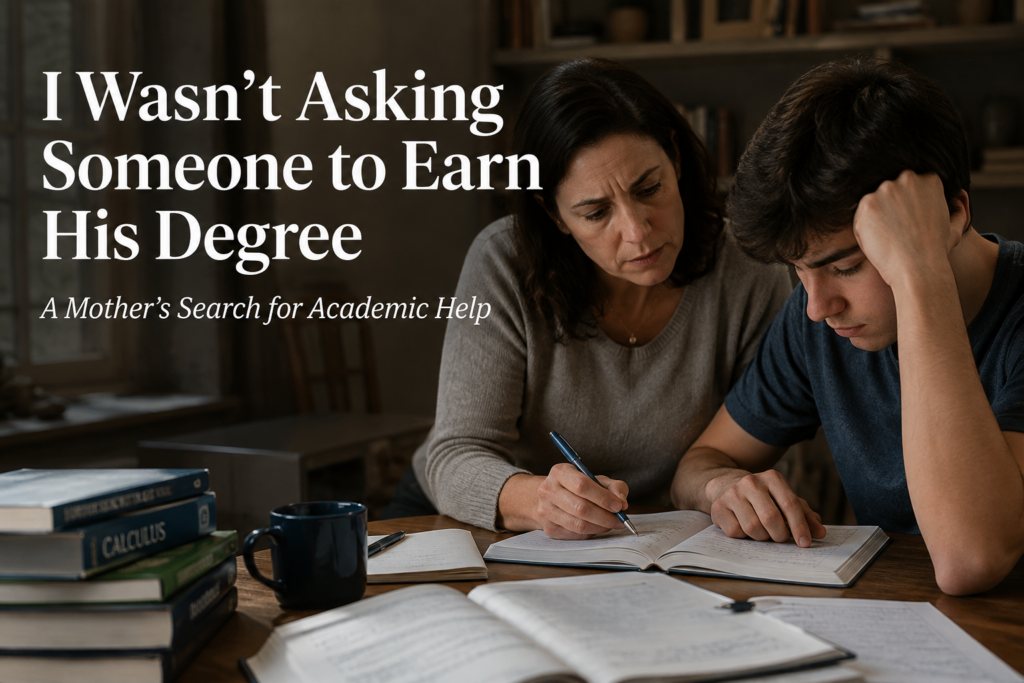
Her son, “Daniel,” was capable of understanding his subjects, but his mental health and overcrowded schedule made consistent academic performance almost impossible. Some weeks he attended classes and completed his work normally. During others, anxiety, exhaustion and disrupted sleep left him unable to begin an essay until hours before the deadline.
“He was not going out and wasting his time,” Lina explained. “Sometimes he sat in front of the computer for six hours. At the end, there were still only two sentences.”
From the university’s perspective, the situation appeared straightforward: Daniel had missed deadlines, submitted incomplete work and failed to demonstrate the required learning outcomes. From his mother’s perspective, however, the grades concealed what was actually happening. Her son was not refusing to learn. He was struggling to convert what he knew into the particular form demanded by the university.
When academic difficulty is also a health problem
Daniel’s experience is not unusual. The American College Health Association reported in its Fall 2024 assessment that 30% of surveyed students said anxiety had negatively affected their academic performance. More than three-quarters reported sleeping fewer than eight hours on an average weeknight. (American College Health Association)
These findings challenge the convenient assumption that every failed assignment reflects laziness or a lack of ability. Mental-health conditions can affect concentration, memory, motivation, communication and time perception. A student may understand a lecture yet remain unable to organise a 2,500-word paper. Another may complete the research but become paralysed by the fear of producing an imperfect first draft.
“People kept telling him to manage his time,” Lina recalled. “But managing time was exactly the thing he could not do when he was unwell.”
The United States Department of Education states that depression may qualify a student for protection under Section 504 when it substantially limits a major life activity. Depending on individual circumstances, reasonable adjustments may be available. However, students usually have to disclose their condition, provide documentation and navigate the institution’s procedures. (U.S. Department of Education)
For an international family unfamiliar with the system, knowing that support theoretically exists is different from successfully obtaining it.
The price attached to failure
The family’s anxiety intensified when Daniel failed a required course. Repeating it would mean more than correcting one grade. It could delay graduation and require another tuition payment, while potentially creating complications involving financial aid or enrolment status.
“How much will it cost if he takes the class again?” Lina remembered asking an adviser.
“That depends on his credit load and financial-aid eligibility,” came the answer.
“So there is no simple second chance?”
“He can repeat the course, but it must be registered and paid for.”
The financial stakes are substantial. According to the College Board, average published tuition and fees for 2025–26 reached $11,950 for in-state students at public four-year institutions and $45,000 at private nonprofit four-year universities. The estimated annual student budget—including living expenses—was $30,990 at an in-state public university and $65,470 at a private nonprofit institution. (College Board)
Not every student pays the published price, and the cost of repeating one course varies considerably. Nevertheless, failure can carry a direct financial penalty. For a family already stretching its resources, paying again does not feel like an educational opportunity. It feels like being charged for falling behind.
The blurred boundary around “help”
Lina began searching for external assistance. She encountered private tutors, editors, study coaches and companies offering complete papers. To her, they initially appeared to belong to the same category.
“I asked a sales representative from a Chinese essay writing website, ‘Can you show him how to organise the essay?’” she said. “The person replied, ‘We can write the whole thing.’ That was when I became uncomfortable.”
This distinction is central to the moral debate. A tutor who explains an assignment, helps a student construct an outline or comments on a draft is supporting the learning process. A third party who writes the assessed work and allows the student to submit it as their own is replacing that process.
The first may be legitimate academic support. The second is contract cheating.
Yet the line can become blurred in practice. How much editing is too much? Can a tutor rewrite a confusing sentence as an example? Is it acceptable to provide a model paragraph? What if the student understands the finished work but could not have produced it alone?
Universities often publish broad warnings about unauthorised assistance without giving students equally clear examples of permitted support. This ambiguity is dangerous because distressed students are not always in a position to interpret fine distinctions.
Merit is never measured in isolation
The ethical problem cannot be resolved simply by declaring that all students must work independently. Students have never competed under identical conditions. Some receive extensive help from educated parents. Some pay for specialist tutoring. Others use university writing centres or private editors. Meanwhile, students working long hours, studying in another language or living with psychiatric conditions may have far less access to informal support.
This does not justify submitting purchased work. It does, however, expose the weakness of treating every grade as a pure measurement of merit. Academic results reflect knowledge and effort, but also health, money, time, cultural familiarity and access to assistance.
“I did not want somebody else to earn his degree,” Lina said. “I wanted someone to teach him how to survive long enough to earn it himself.”
That sentence captures the legitimate role of external academic support. Ethical assistance should increase a student’s capacity rather than disguise its absence. It can break an assignment into manageable steps, explain assessment criteria, teach research methods and provide feedback. The student must still make the intellectual decisions and remain responsible for the submitted work.
Universities also have obligations. They should provide accessible counselling, transparent accommodation procedures, affordable tutoring and early intervention before one failed essay becomes a failed semester. Assessments should allow students to demonstrate learning without making their success depend entirely on speed, stamina or prior familiarity with academic conventions.
The real question is therefore not whether struggling students deserve help. They clearly do. The question is what kind of help preserves education rather than replacing it. A fair system must maintain academic integrity while recognising that unsupported hardship is not the same thing as merit.

