


 DOI : 10.17577/
For businesses that rely on sensitive electronic equipment, preserving the cleanliness of components can be a major priority as part of routine maintenance.
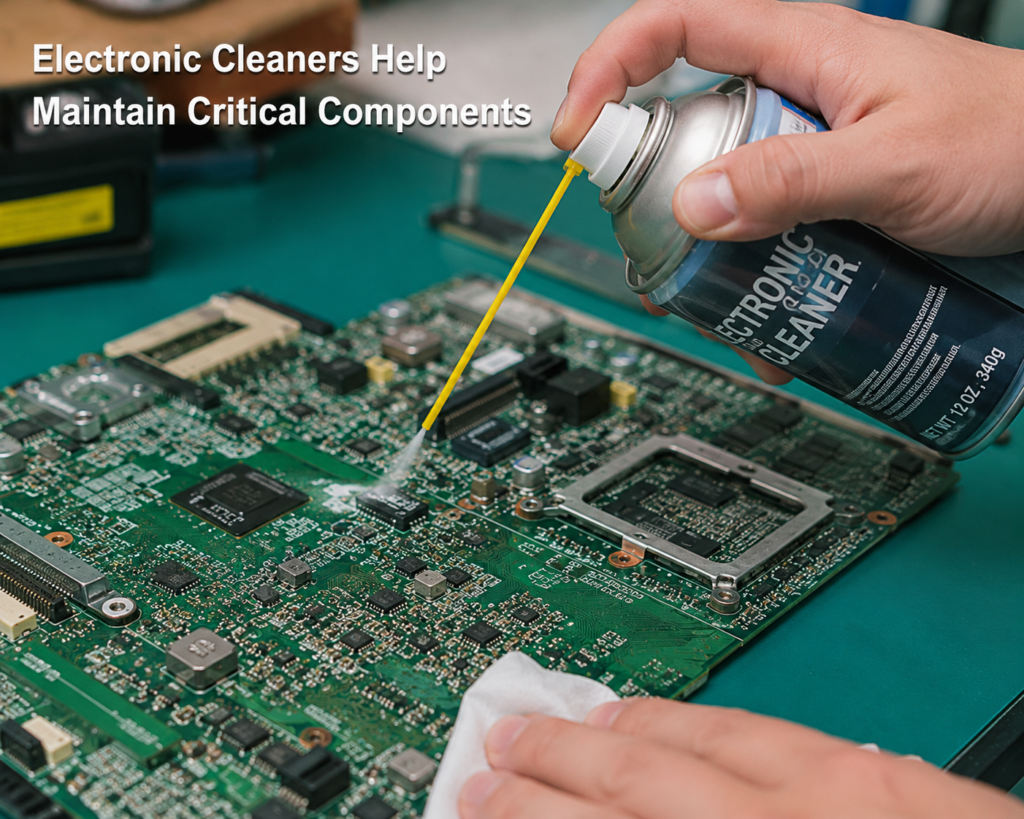
The appropriate use of electronics cleaning products from RS can help remove contaminants from circuit boards, connectors, contacts, and other critical components.
This, in turn, can be central to efforts to support long-term functionality and efficiency, while helping to reduce the risk of contamination-related equipment failures.
How Do Components Get Contaminated in The First Place?
There are various ways in which electronic components and assemblies can become contaminated.
Residues can be left behind from manufacturing and assembly processes. Meanwhile, machinery operating in workshops, factories, and other industrial settings may be exposed to dust, airborne particles, oils, and other substances.
The direct handling of equipment can bring in contaminants, too. For instance, maintenance or assembly work may introduce skin oils and other residues that could impact on electrical contacts or create other problems over time.
This is before maintenance decision-makers even account for broader environmental conditions that can contribute to contamination. High humidity, airborne pollutants, and chemical exposure may heighten the risk of corrosion and other forms of degradation.
Why Is It So Important for Critical Components to Be Kept Clean?
When contaminants ranging from soldering flux residues and fingerprints to dust, oxidation, and ionic particles are present, this can create pathways for electrical leakage, promote corrosion, and/or potentially affect electrical performance.
In sectors where the highest levels of reliability are critical, such as aerospace, defence, medical equipment, and industrial automation, there can be particularly low tolerance for issues arising from contamination. Failures in such industries can lead to downtime, safety concerns, and regulatory or compliance consequences.
It should be clear to all relevant stakeholders, then, that the thorough and effective cleaning of critical components is not merely a “cosmetic” issue. It can, instead, be an important part of ongoing maintenance and quality assurance.
How Do Electronic Cleaners Work?
Wherever the term “electronic cleaners” is used, this is typically a reference to cleaning products that are specially designed to remove unwanted substances from electronic components and assemblies.
Crucially, these cleaners are formulated to avoid unnecessary damage being caused to sensitive materials. Many electronic cleaners are formulated to evaporate quickly and leave little or no residue. Meanwhile, some are designed to be non-corrosive and compatible with particular metals, plastics, and coatings, provided they are used correctly.
Examples of frequently used electronics cleaners encompass solvent-based contact cleaners, flux removers, isopropyl alcohol (IPA) blends, and specialised precision cleaners. They typically work by dissolving, loosening, and flushing away contaminants from surfaces and hard-to-reach areas around and beneath components.
Contact cleaners, for instance, can help address oxidation and debris as a means of restoring conductivity on switches, relays, and connectors. Flux removers, meanwhile, target the post-soldering residues that general-purpose solvents may not readily remove.
It is important to note, though, that the formulations of electronic cleaners vary considerably. Some products may be intended for particular materials, components, and/or applications.
In light of this, maintenance teams should always check the cleaner manufacturer’s instructions and, where applicable, the equipment or component manufacturer’s guidance before use.
Final Thoughts: The Right Electronic Cleaners Are an Imperative Investment
Appropriately selected electronics cleaners can play an important role in safeguarding critical components. This reflects their effectiveness in removing contaminants that threaten equipment performance.
In today’s era of ever-more complex and compact electronics, this straightforward step remains a key consideration for many maintenance teams.
When incorporated into a properly planned maintenance programme, electronic cleaning can be an important measure for protecting the dependability, safety, and operational continuity of machinery across a multitude of sectors.

