



 DOI : 10.17577/
Model selection deserves the same rigour as any other engineering decision. Photo via Unsplash.
Abstract. Text-to-image generation models are increasingly integrated into engineering workflows, from technical documentation and product visualisation to training material and user interface prototyping. Selecting a model is often based on informal impressions from a few sample images. This article proposes a lightweight, repeatable evaluation protocol based on five measurable dimensions: prompt adherence, text rendering, effective resolution, latency and cost per accepted image. A worked example using a current commercial model illustrates how the protocol can be applied and how its results support procurement and integration decisions.
1. Introduction
Diffusion-based and related image generation models have improved rapidly. Current systems can produce photorealistic scenes, follow complex instructions and render legible text inside images, a task that earlier generations handled poorly. For engineering teams, the question is no longer whether such models are useful, but which model is fit for a specific purpose and at what operating cost.
Informal evaluation has two weaknesses. It tends to over-weight visually striking outputs, and it rarely captures failure rates, which drive real cost. A structured protocol addresses both by testing many prompts, scoring each output against explicit criteria and reporting the cost of producing an acceptable result rather than the cost of a single generation.
2. Evaluation dimensions
The protocol uses five dimensions. Each is chosen because it can be measured with modest effort and because it directly affects whether a model is usable in production.
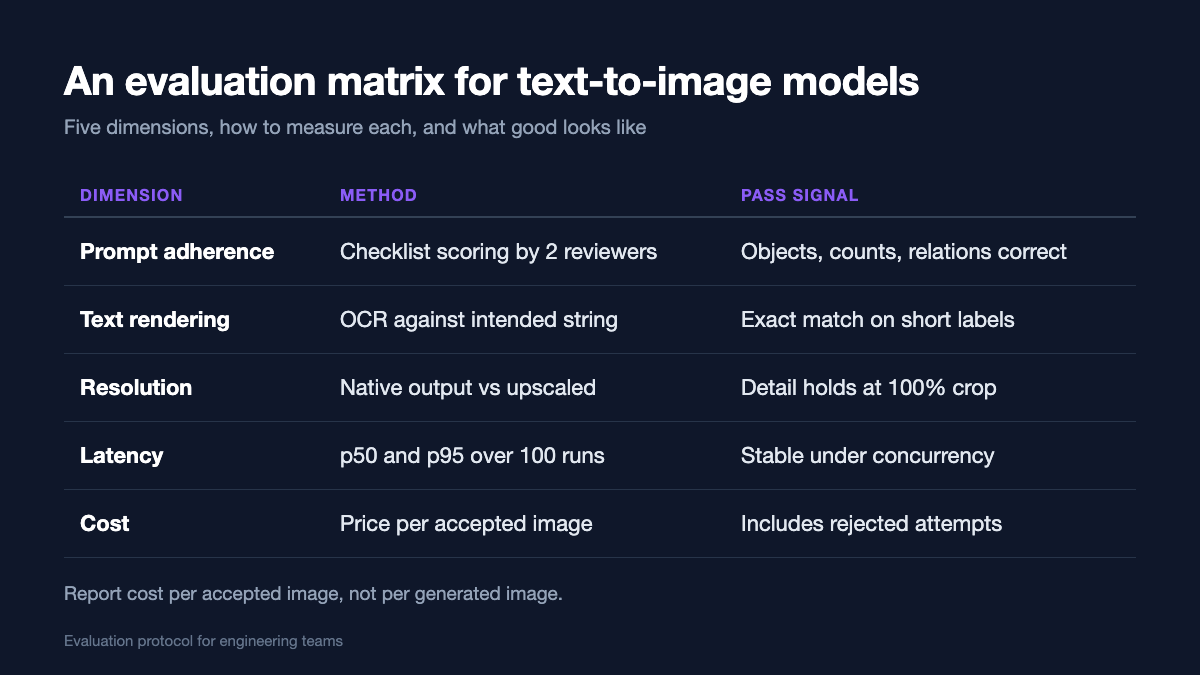 Five dimensions, each with a measurement method and a pass signal.
2.1 Prompt adherence. Adherence measures whether the image contains the requested objects, counts, attributes and spatial relations. Each test prompt is decomposed into a checklist of verifiable elements, for example “three gears”, “blue housing” and “label on the left”. Two reviewers score each element independently, and disagreements are resolved by discussion. The adherence score is the proportion of checklist items satisfied.
2.2 Text rendering. Many engineering images require labels, part numbers or interface text. Rendered text is extracted with optical character recognition and compared with the intended string. Exact match is recorded for short labels, and character error rate for longer strings. This dimension separates models more sharply than almost any other.
2.3 Effective resolution. Nominal output resolution does not guarantee usable detail. Outputs are inspected at full size for texture, edge sharpness and artefacts. Where a model offers several resolutions, each is tested separately, since quality and cost both change.
2.4 Latency. Latency is measured as wall-clock time from request submission to result availability, over at least one hundred runs. Both the median and the 95th percentile are reported, and tests are repeated at modest concurrency to reveal queueing effects in asynchronous APIs.
2.5 Cost per accepted image. The most important economic measure is not the price of one generation but the total cost of producing one image that passes review. If a model requires three attempts on average, its effective cost is three times its list price, plus reviewer time.
3. Test set design
A useful test set contains between fifty and one hundred and fifty prompts drawn from the intended application. For a documentation team, this might include exploded component views, labelled diagrams, interface mock-ups and photorealistic product renders. The set should deliberately include difficult cases: multiple objects with specific counts, precise colour requirements and short text labels. Prompts are fixed and version-controlled so that results can be compared across models and over time.
4. Worked example
As an illustration, the protocol can be applied to ByteDance’s Seedream 5.0 Pro, a quality-oriented text-to-image model that supports 1K, 1.5K and 2K outputs as well as exact pixel sizes, accepts up to ten reference images, and combines generation and editing in a single call. Its emphasis on text rendering makes it a relevant candidate for labelled technical imagery.
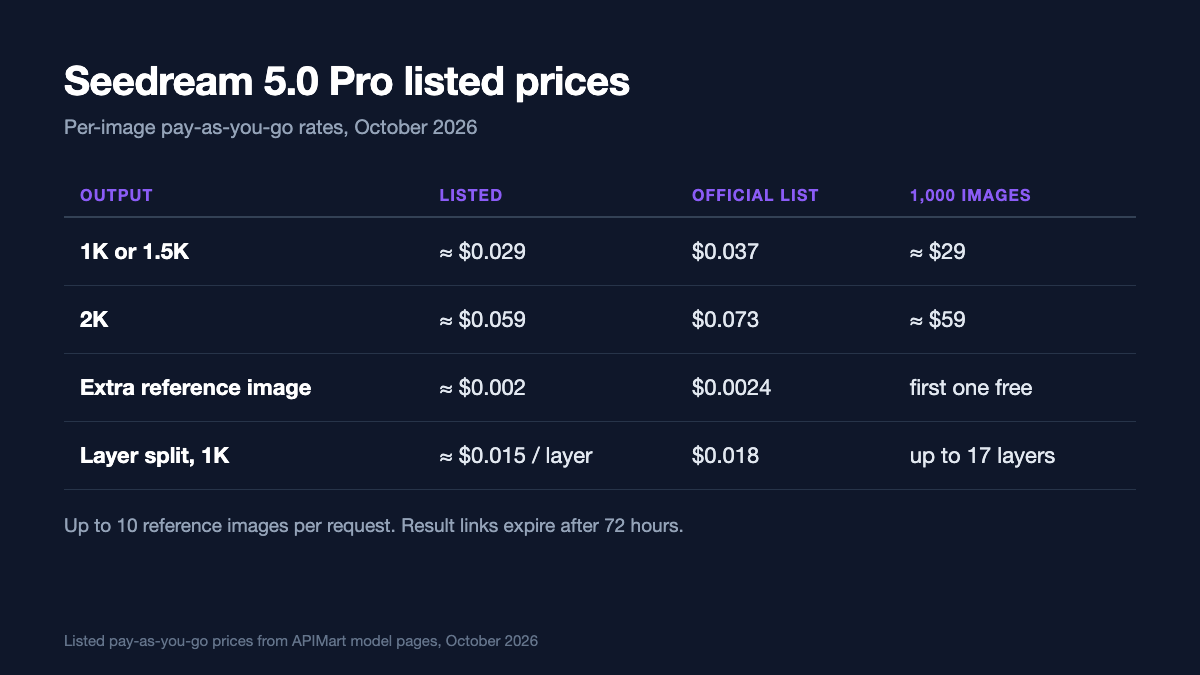 Listed per-image rates used as the cost input in the worked example.
For the cost dimension, the listed pay-as-you-go rate for Seedream 5.0 Pro on APIMart is approximately $0.029 per image at 1K or 1.5K and $0.059 at 2K, compared with official list prices of about $0.037 and $0.073. The first reference image is free, and additional references cost roughly $0.002 each. A layer decomposition mode, which splits an image into separately editable layers, is listed at about $0.015 per output layer at 1K. Result links expire after seventy-two hours, which has implications for storage design.
Using these planning figures, the cost per accepted image follows directly from the measured acceptance rate:
|
Acceptance rate |
Attempts per accepted image |
Cost per accepted 1K image |
Cost per accepted 2K image |
|
90% |
1.11 |
≈ $0.032 |
≈ $0.065 |
|
70% |
1.43 |
≈ $0.042 |
≈ $0.084 |
|
50% |
2.00 |
≈ $0.058 |
≈ $0.118 |
|
30% |
3.33 |
≈ $0.097 |
≈ $0.195 |
The table shows why acceptance rate matters more than list price. A model that is cheaper per generation but accepted only thirty percent of the time can easily cost more per usable image than a more expensive model with a high acceptance rate, before reviewer time is even considered.
5. Integration considerations
Several engineering factors fall outside the five scored dimensions but affect total cost of ownership. Most image APIs are asynchronous: a request returns a task identifier, and the client polls for completion. Clients must handle timeouts, retries and failures gracefully. Because result links are temporary, outputs should be copied to durable storage immediately. Every request should be logged with its prompt, parameters, model version, latency and cost, so that evaluation results can be reproduced and production behaviour monitored.
Governance also matters. Teams should confirm licensing terms for commercial use, document which outputs were generated and how, and maintain human review for any image that represents a real product, component or safety-relevant instruction.
6. Reporting results
Results are most useful when they are reported in a consistent format that decision makers can read quickly. A one-page summary per model should list the test set version, the date of testing, the resolution tested and the five dimension scores, together with the measured acceptance rate and the resulting cost per accepted image. Including a small grid of representative successes and failures helps readers understand what the numbers mean in practice.
When several models are compared, a simple weighted score can support the decision, with weights agreed in advance based on the application. A documentation team might weight text rendering and adherence heavily, while a marketing team might give more weight to visual quality and speed. Agreeing the weights before testing avoids the temptation to adjust them after seeing which model performs best. All raw scores, prompts and outputs should be archived so the evaluation can be audited or repeated when models or prices change.
7. Limitations
The protocol relies partly on human judgement for adherence scoring, which introduces reviewer variance. Using two reviewers and explicit checklists reduces but does not eliminate this. Latency measurements reflect conditions at the time of testing and can vary with provider load. Prices change frequently, so cost results should be recalculated whenever rates are updated.
8. Conclusion
A structured evaluation across adherence, text rendering, effective resolution, latency and cost per accepted image gives engineering teams a defensible basis for selecting text-to-image models. The protocol requires a modest test set and a few days of effort, can be rerun whenever new models are released, and shifts the discussion from impressive samples to measurable fitness for purpose. In practice, reporting cost per accepted image, rather than cost per generation, is the single change that most improves the quality of model selection decisions.

