


 DOI : 10.17577/
Picking a voice-agent stack in 2026 is less about finding a single “winner” and more about matching how your team builds, ships, and operates calls.
Retell AI is a solid production option many teams already trust. Still, you may want more features or a better capability fit for your specific needs.
If yes, then keep reading the article below, which reviews 3 platforms that often land on that shortlist: Telnyx, Vapi, and Synthflow.
TL;DR
- Strong fit for carrier + compute under one roof: Telnyx. Telephony, speech, inference, and orchestration sit on the same stack, with model bring-your-own flexibility and end-to-end tracing when you need to diagnose a call path.
- Strong fit for modular builder control: Vapi. Orchestration and infra that does not force a single STT/LLM/TTS combo, plus multi-agent Squads when handoffs matter.
- Strong fit for enterprise voice OS + SIP/CCaaS depth: Synthflow. BELL lifecycle, in-house telephony, and deep contact center integrations when you need more than an agent canvas.
Why Looking for Retell AI Alternatives?
Looking at alternatives does not mean Retell is a weak product. Retell remains a strong production choice for teams that want a capable voice-agent platform and are happy with that fit. Teams shop around when they need a different slice of the stack:
- Some want a carrier-owned path where telephony and compute live under one accountability model.
- Others want modular control over STT, LLM, and TTS so they can swap providers without rebuilding the whole agent.
- Enterprise buyers often look for a voice OS with lifecycle tooling, SIP/PBX connectivity, and contact center integrations that go beyond a pure agent builder canvas.
In short: this is about fit, not failure. Retell can still be the right answer. These alternatives simply solve adjacent jobs for teams whose constraints or roadmap point elsewhere.
Quick Comparison Table
| Capability | Telnyx | Vapi | Synthflow |
| Core fit | Carrier + compute under one roof | Modular orchestration/builder control | Enterprise voice AI OS |
| Telephony | Own carrier path; licensed; wide international reach | Custom SIP, number management, warm transfers, DTMF, voicemail detection | In-house telephony; SIP/PBX; bring own carriers/trunks; CCaaS fit |
| Multi-agent | Tools for transfers, memory, calendar, CRM, MCP | Squads with handoffs/routing | Multi-agent subflows |
| Languages | Multi-engine STT / multi-provider TTS catalog | English, Spanish, Mandarin, and 100+ others | 30+ languages + global number provisioning |
| Compliance framing | SOC 2 Type II; GDPR/PCI/HIPAA | SOC 2, HIPAA, PCI framing; SSO, OAuth, RBAC; conversation guardrails | SOC 2, HIPAA, PCI DSS, GDPR; encryption, audit logs, region hosting |
| Best for | One accountability model for telephony + AI | Code-level layer control without a fixed combo | Voice OS depth with SIP/CCaaS and lifecycle loops |
-
Telnyx
Overview
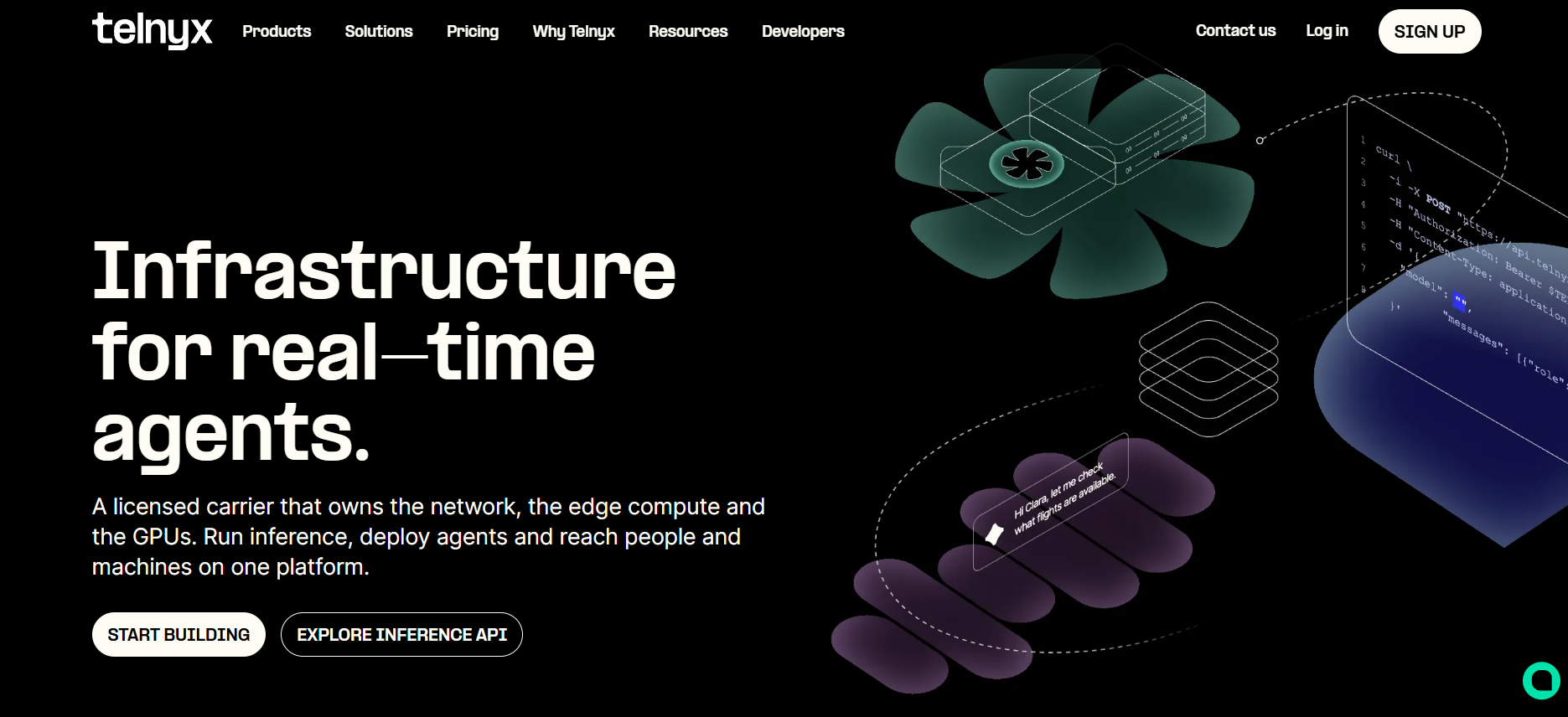
Telnyx is built for teams that want telephony and AI compute under one roof, including teams building a voice AI agent. Because it runs its own carrier path and co-locates GPUs at points of presence, you can place STT, inference, TTS, and orchestration on a single stack with a single accountability model.
- You can work through APIs or a no-code builder with an in-browser simulator, bring or swap OpenAI-compatible models, and ground agents with knowledge from files and URLs. Outbound calling benefits from A-level STIR/SHAKEN eligibility in the US, licensed carrier status, and reach across 45+ countries. When something goes wrong on a call, end-to-end tracing, latency breakdowns, and transcript playback help you see where time and quality were spent.
The platform also exposes 30+ integrations, multi-engine STT behind one API, a large multi-provider TTS catalog, and tools for transfers, memory, calendar, CRM, and MCP, with default noise suppression.
Strengths
The standout is owning the path from the phone network into speech and inference, then back out as voice, without stitching separate vendors for each hop. That co-located design supports descriptive response targets in the sub-200ms range on the owned path and sub-100ms inference on owned GPUs, while model bring/swap and tracing keep you flexible when you need to change engines or debug a single call.
Limitations
Telnyx is less of a call center ops canvas first. If your priority is a heavy contact center workflow surface or a pure agent builder experience without caring who owns the carrier layer, you may find the fit clearer elsewhere.
-
Vapi
Overview
Vapi is builder-oriented orchestration that leaves STT, LLM, and TTS open.
- You design Assistants and Squads, pick models through API or UI, and keep natural turn taking, human-like voices, and custom pronunciation in play. Mid-call tools and live data stay available, with 200+ models and integrations plus bring-your-own keys, modular swaps, and automatic failover when a provider falters. Telephony covers custom SIP, warm transfers, voicemail detection, numbers, and DTMF, while multi-agent Squads handle handoffs and routing across English, Spanish, Mandarin, and 100+ other languages.
And finally, automated testing and evals watch hallucination risk, and A/B testing plus analytics keep prompts, voices, flows, and review in one loop.
Strengths
Vapi shines when you want code-level control of every layer and the freedom to swap providers without rebuilding the agent. Latency is framed around under 500ms / sub-500ms as descriptive context rather than a ranking claim, while Squads, live tools, and evals/A/B loops give builders a practical way to ship multi-agent flows and keep quality measurable.
Limitations
Vapi may feel more like modular orchestration than a phone-ops-first or contact center OS. So, teams that prefer a single vendor stack over mix-and-match providers should weigh that preference carefully.
-
Synthflow
Overview
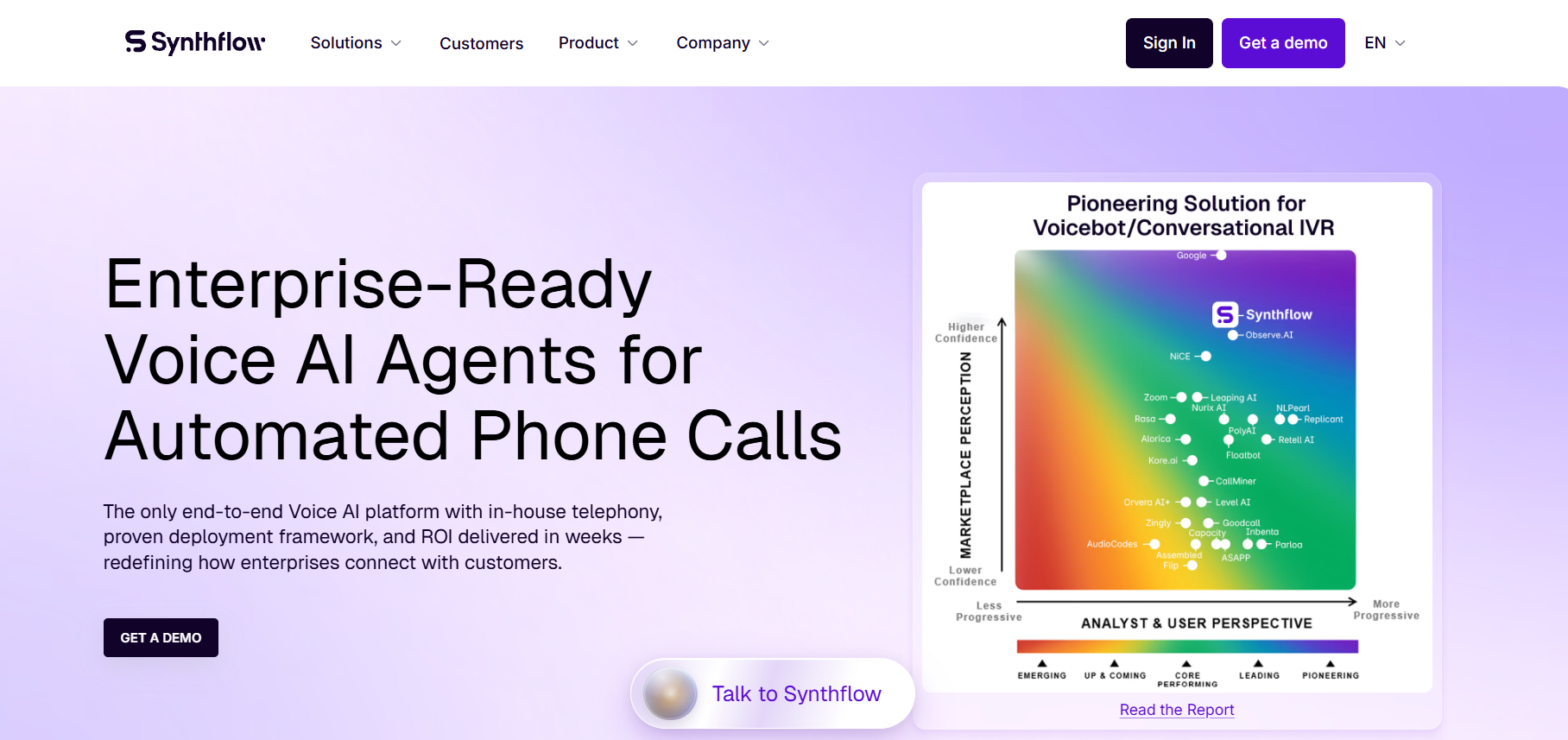
Synthflow positions itself as a full voice AI OS with in-house telephony and a BELL lifecycle (Build, Evaluate, Launch, Learn).
- You can connect SIP/PBX, bring your own carriers and trunks, and fit enterprise stacks like Cisco, Avaya, Genesys, and RingCentral, with 200+ CRM, CCaaS, and calendar-style integrations. Multi-agent subflows, an AI sandbox for preview, compare, version, and rollback, plus live visibility across calls, webhooks, and APIs keep ops tight, while omnichannel covers voice, chat, and SMS.
Built-in workflows handle appointments, human transfer, voicemail detection, confirmations, and CRM updates across 30+ languages with global number provisioning.
Strengths
The lifecycle loop is the real differentiator: you are not only designing an agent, you are also evaluating against KPIs, launching on a network you can connect deeply, and learning from Auto-QA and live monitoring. So, Synthflow fits teams that need an enterprise voice OS more than a pure agent builder canvas.
Limitations
If your team mainly wants a lightweight modular builder with maximum provider swap at the STT/LLM/TTS layer, Synthflow can feel heavier than you need.
Wrap Up
Voice agent stacks in 2026 are a fit exercise, not a popularity contest.
Start from the job your calls have to do, then pick the slice of the stack that matches how you build and operate.
- Choose Telnyx when you want carrier and compute under one roof, model swap with tracing, and less emphasis on a call-center ops canvas first.
- Choose Vapi when you want code-level control of every layer, modular provider choice, and multi-agent Squads with handoffs.
- Choose Synthflow when you want an enterprise voice OS with Build-Evaluate-Launch-Learn and deep SIP/CCaaS connectivity.

