


 DOI : 10.17577/
Induction heat treating alters the surface or bulk properties of a metal component using electromagnetic induction rather than combustion or resistance heating. Instead of heating the entire mass in a furnace, an induction system generates heat directly within the workpiece using an alternating magnetic field. The distinction matters more than it sounds, because it changes what an engineer can control: how deep the heat penetrates, how fast the cycle runs, and how much of the part is affected at all.
This overview covers the physics behind the process, a data-grounded comparison against conventional furnace-based heat treatment, and the industrial sectors driving adoption through 2030. It is written for engineers and researchers evaluating process selection, not as a sales pitch for one method over another. Both approaches remain in active industrial use, and the metallurgical literature shows real trade-offs between them.
How Induction Heat Treating Works
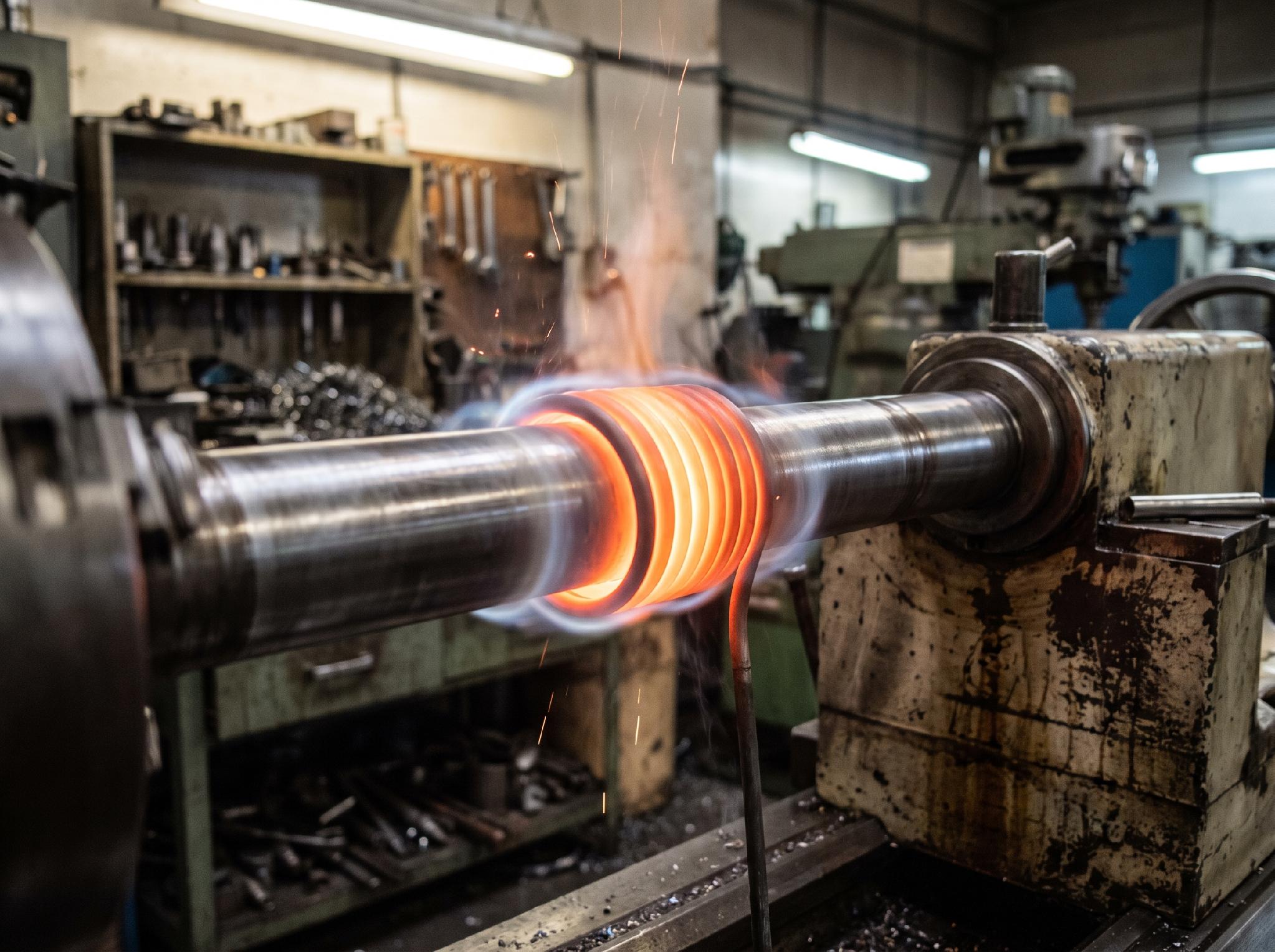
Electromagnetic induction concentrates heat at the surface layer of a rotating steel shaft, enabling precise, localized hardening without heating the core.
The process starts with an alternating current run through a copper coil positioned around or near the workpiece. That current generates a fluctuating magnetic field, which induces eddy currents inside the metal. Those eddy currents meet electrical resistance in the material and generate heat directly, a mechanism known as Joule heating. No flame touches the part, and no external heat source needs to reach thermal equilibrium with it first.
A phenomenon called the skin effect concentrates most of this induced current near the surface of the workpiece. Higher frequencies push the heating effect shallower; lower frequencies let it penetrate deeper toward the core. This is why frequency selection is one of the first engineering decisions in any induction process, along with coil geometry, because both determine case depth and heating uniformity for a given part shape. A rapid quench, using water, oil, or a polymer solution, follows the heating cycle to lock in the desired microstructure. Providers offering commercial induction heat treating services configure frequency, coil design, and quench parameters around the specific geometry and case-depth requirements of each component, since a crankshaft journal and a thin-wall tube call for very different setups. The process is non-contact, flameless, and repeatable enough that most production lines run it under closed-loop automation.
Industrial Applications of Induction Heat Treating
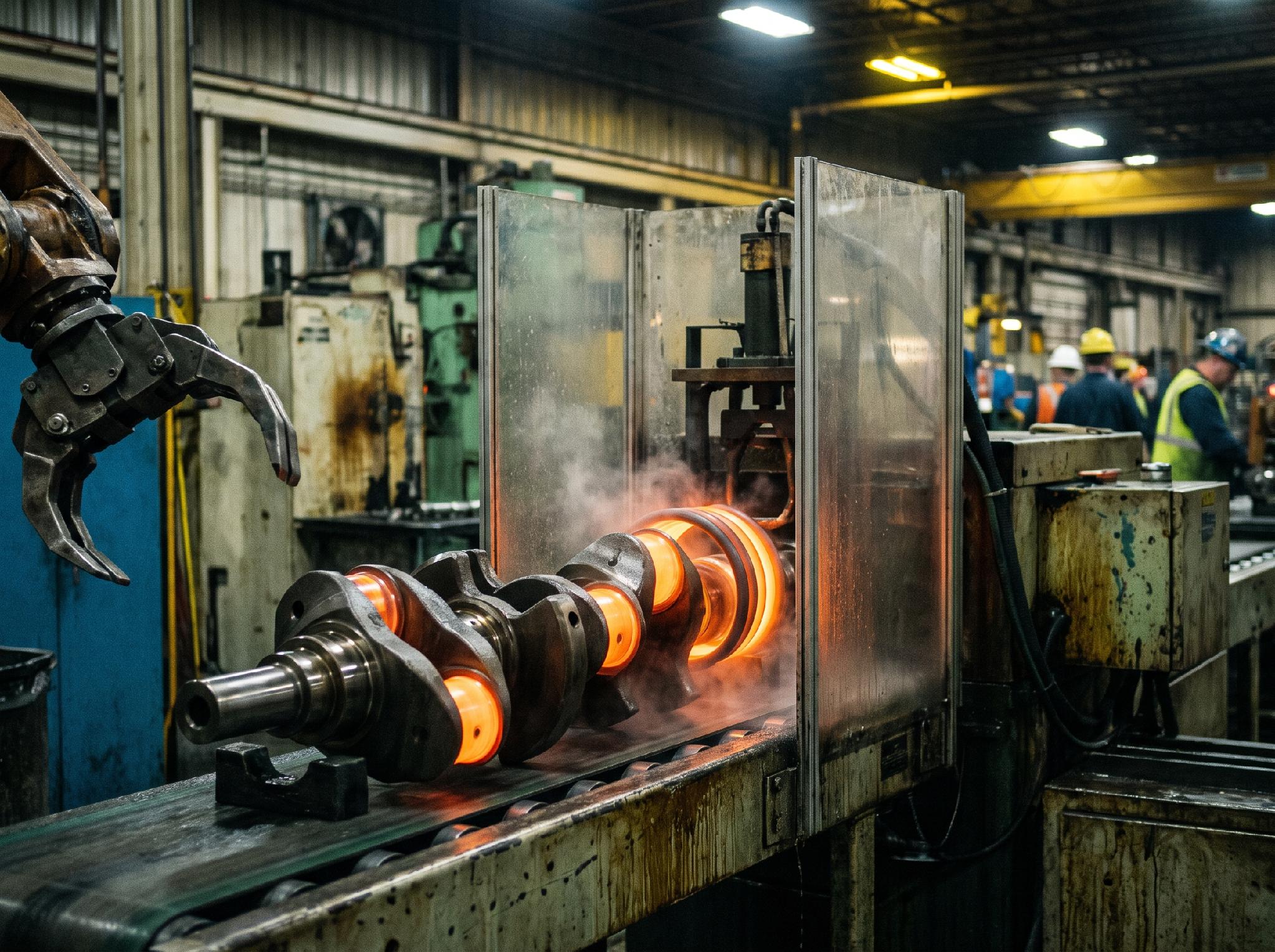
Induction heat treating equipment hardens a crankshaft on an automated production line, a common application in automotive manufacturing.
Automotive manufacturing remains the largest consumer of induction heat treating capacity. Crankshafts, camshafts, gears, and CV joints all need wear-resistant surfaces without sacrificing the ductile core that absorbs shock loads, and induction hardening delivers that combination reliably at production speed. Aerospace applications lean on the same principle for ball screws and electromechanical actuator components, where consistent case depth is a certification requirement, not a nice-to-have. Oil and gas operators use it on drill components and pipe fittings that need surface hardness in corrosive, high-friction downhole environments.
A newer demand driver is the EV component segment: motor shafts, inverter housings, battery cooling plates, and copper busbars all require precision heat treatment that furnace processing struggles to match at the tolerances EV manufacturers specify. According to MarketsandMarkets’ Induction Heating Market Report (2025-2030), the induction heating segment used specifically for heat treating was valued at USD 157.6 million in 2024 and is projected to reach USD 242.8 million by 2030, a 7.5% compound annual growth rate that makes heat treating the largest single application segment in the broader induction heating market. The same report identifies the 10-100 kW power range as the workhorse band for this work, covering most automotive part hardening, forging, brazing, and induction annealing applications, and values that segment at USD 257.1 million in 2024, growing to USD 392.8 million by 2030.
Induction vs. Conventional Heat Treatment: A Technical Comparison
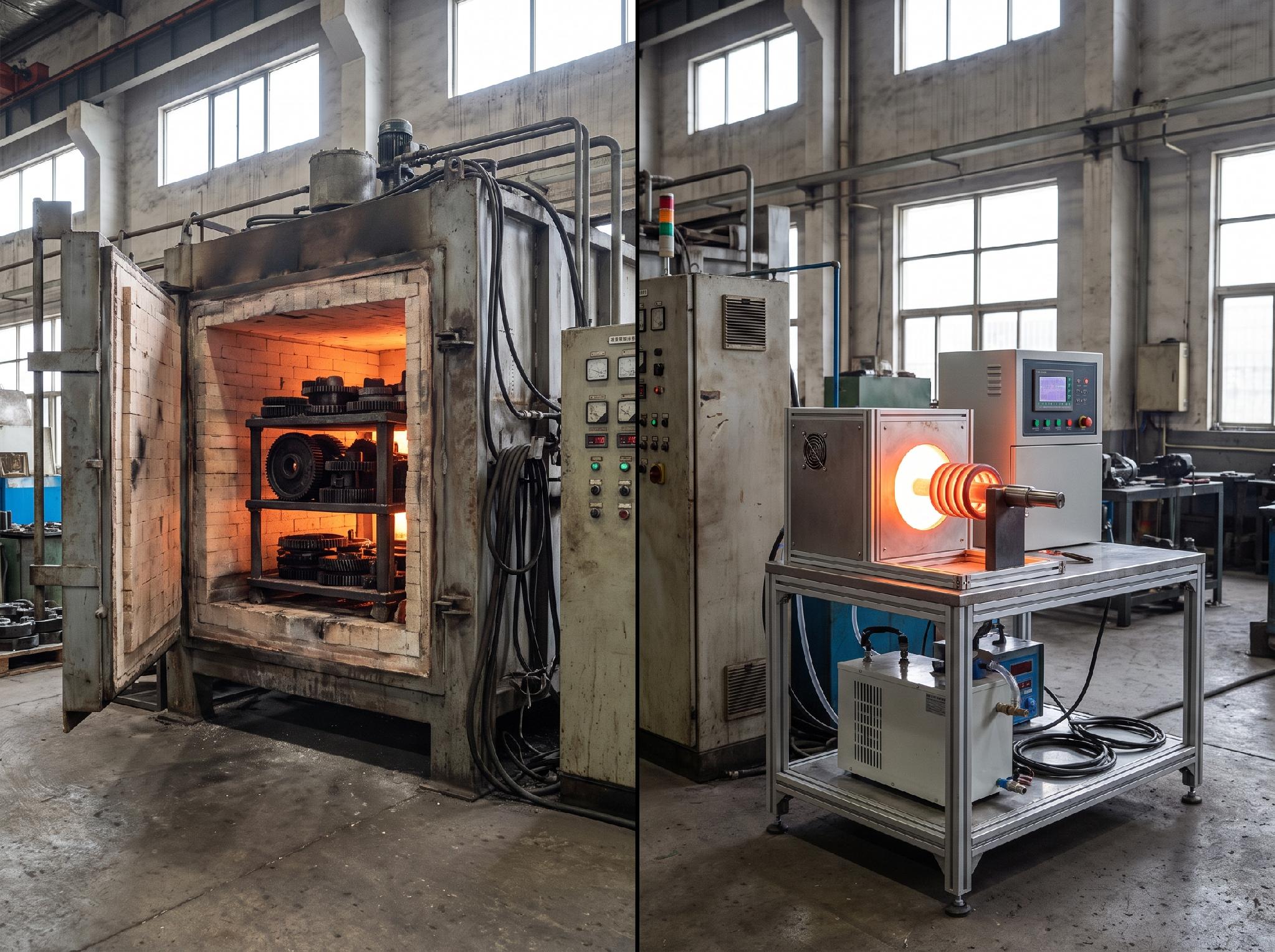
Furnace-based heat treatment heats an entire component, while induction systems apply heat only where needed, reducing energy use and distortion.
Induction heat treating’s efficiency advantage over furnace-based methods is well documented, though the size of that advantage depends heavily on which comparison you’re reading. Ultraflex Power Technologies has cited energy efficiency gains of up to 95% over conventional furnace heating in certain process comparisons, while ProleanTech puts the more conservative figure at roughly 40% lower energy use than conventional methods. The gap between those numbers comes down to what’s being compared: heating an entire furnace chamber versus heating only the surface layer of a single part is a fundamentally different energy budget than a full-load batch furnace running near capacity. Selective heating also means shorter cycle times, less scaling, and less thermal distortion, since only the targeted region ever reaches transformation temperature.
But induction isn’t a strict upgrade over conventional treatment in every metric, and the research literature is clear about that. A published metallurgical study on 42CrMo4 steel, comparing conventional heat treatment against induction hardening, found that conventionally treated specimens showed slightly higher yield strength and hardness than their induction-treated counterparts. Electron back-scatter diffraction in that study also showed a smaller grain block size in the conventionally hardened sample, along with more uniform carbon distribution, while the induction-hardened specimens showed non-uniform carbon distribution but roughly 30 J/cm2 higher impact energy. In plain terms, conventional treatment produced a more homogenous microstructure with marginally better strength and hardness, while induction treatment produced a part that absorbed more energy before fracturing. Neither result is universally “better.” It depends on whether the application prioritizes peak hardness or impact toughness, and that’s a part-specific engineering call, not a default answer. The ASM Handbook, Volume 4C, Induction Heating and Heat Treatment, edited by Valery Rudnev and George E. Totten, remains the standard reference for working through these trade-offs at the process design stage.
Process Considerations for Engineers
Case depth control comes down almost entirely to frequency selection and power density, since higher frequencies limit penetration to a thin surface layer while lower frequencies drive the heating effect deeper toward the core. Quench media selection follows the same part-specific logic: water quenches faster and produces harder cases but carries a higher risk of distortion and cracking, while oil and polymer quenches trade some hardness for better dimensional stability in complex geometries. Coil design is where much of the engineering effort actually goes, because a coil shaped for a straight shaft won’t distribute heat evenly around a gear tooth profile or an irregular casting.
Quality assurance typically follows the inspection methods outlined in ASM’s standards literature: hardness testing at defined depth intervals, case depth verification through microsectioning, and non-destructive testing for surface cracks introduced during rapid quenching. Engineers researching this area further may want to look at prior published research on tempering process parameters and their effect on mechanical properties in power transmission components, as well as literature reviews on how heat treatment affects the mechanical properties of aluminum alloys in the 6xxx series, both of which cover adjacent ground on how process parameters translate into measurable material performance.
Conclusion
Induction heat treating isn’t a universal replacement for furnace-based methods, and treating it that way misreads the metallurgical evidence. It’s a precision tool best suited to selective hardening, high-throughput production, and applications where energy efficiency and distortion control matter more than the marginal hardness advantage conventional treatment can offer. The 42CrMo4 steel research makes that trade-off explicit rather than theoretical.
What’s changing is the mix of parts pushing engineers toward induction in the first place. Automotive and aerospace demand has driven this market for decades, but EV components, with their tight tolerances and copper-heavy assemblies, are adding a new and fast-growing category of parts that need exactly what induction does well: fast, localized, repeatable heat treatment without the thermal footprint of a furnace. As that segment scales toward 2030, process selection will keep coming down to the same question it always has: what does this specific part need, and which method gets it there without over-promising on the rest.

