


 DOI : 10.17577/
A grant proposal can be scientifically sound and still be difficult to fund. The problem is rarely grammar alone. Reviewers are being asked to judge whether the proposed work matters, whether the central premise is supported, whether the experiments can answer the questions being asked, whether the team can execute them, and whether the likely contribution justifies limited funding. A proposal can become vulnerable at any one of those points.
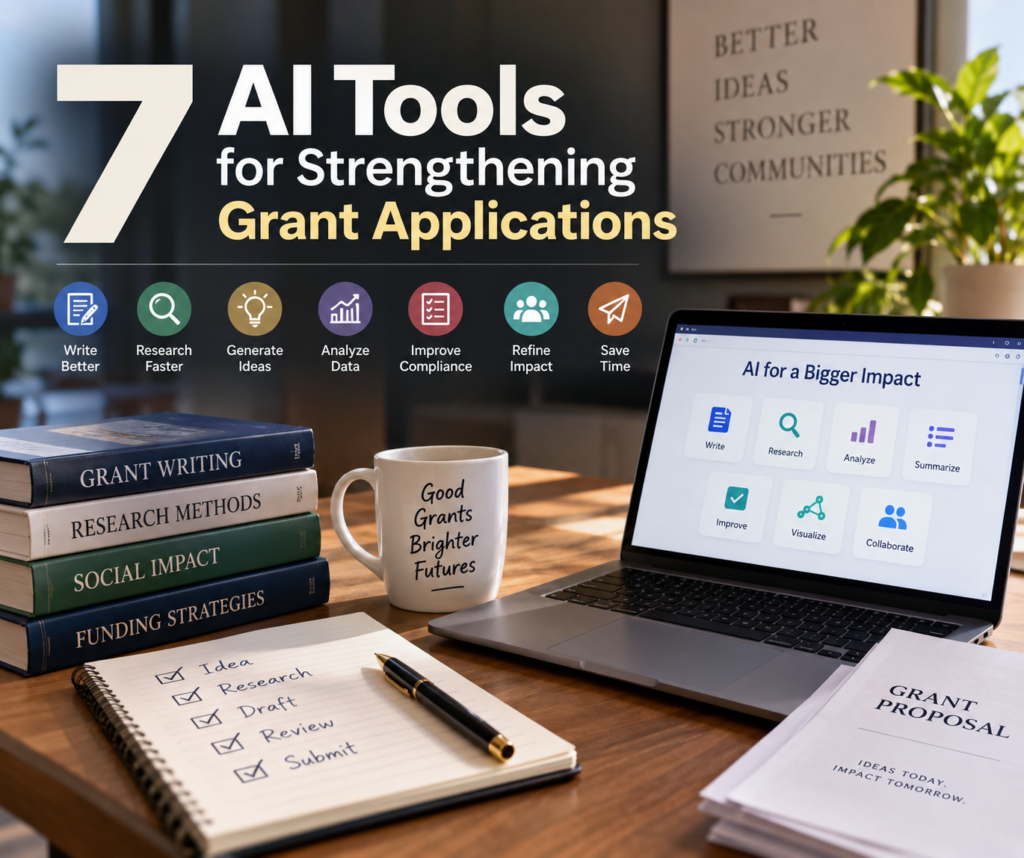
7 AI Tools for Strengthening Grant Applications Before Review
1. QED Science
QED Science is the best option for researchers who want to pressure-test a grant’s science rather than simply improve its language.
Its approach is built around scientific evaluation. Instead of treating a proposal as one large piece of text, the system examines the claims and reasoning that hold the research plan together. For grant applications, that can expose problems involving the central hypothesis, supporting evidence, experimental design, feasibility, novelty, internal consistency, and the relationship between individual parts of the proposal.
This distinction matters during final review. A beautifully written proposal can still depend on a weak premise. An ambitious aim can still lack the experiment required to resolve it. Preliminary data can be persuasive without actually supporting the inference the applicant makes from it.
QED is designed to identify those kinds of gaps and provide structured feedback researchers can use before submission. It can also help assess whether claims are supported internally and how they stand against the wider scientific literature.
Rather than functioning as another writing assistant, it effectively adds a scientific critique stage to the grant workflow.
Key Features
- Grant-specific scientific proposal review
- Claim-level reasoning evaluation
- Hypothesis and premise assessment
- Experimental design critique
- Feasibility analysis
- Evidence and logic gap identification
- Scientific originality evaluation
- Structured recommendations before submission
2. Elicit
Elicit is especially useful when strengthening a grant requires a more systematic examination of the evidence behind its scientific premise. Grant writers frequently need to establish more than the existence of prior research. They need to demonstrate what is known, where findings converge, where evidence remains limited, and why the proposed study fills a meaningful gap.
Elicit helps researchers search scientific literature, screen papers, extract structured information, compare studies, and synthesize evidence across a larger body of work. That makes it useful during the evidence audit that should happen before submission.
Key Features
- AI-assisted academic literature search
- Multi-paper evidence synthesis
- Structured study data extraction
- Systematic review workflows
- Paper screening and comparison
- Research report generation
- Source-backed research answers
3. Scite
A grant proposal can contain an impressive bibliography and still rest on fragile citations. Scite is useful because it looks beyond whether a paper has been cited and examines how later research has cited it. Its Smart Citations framework distinguishes citation statements that support, contrast with, or simply mention previous work.
That additional context can matter enormously during grant preparation. Imagine that a foundational paper is used to support the biological premise for an entire aim. The paper is highly cited, so it appears authoritative. Yet several subsequent studies have failed to reproduce part of the result or have challenged the interpretation.
Key Features
- Smart Citation analysis
- Supporting and contrasting citation identification
- Citation-context exploration
- Reference checking
- Evidence-backed research search
- Literature credibility assessment
- Citation history analysis
4. Consensus
Consensus provides a faster route into the peer-reviewed evidence surrounding a scientific question. Researchers can ask questions in natural language and use the platform to identify relevant research and understand the general direction of published evidence. This can be helpful during grant preparation when applicants need to check whether statements in the proposal still accurately represent the field.
Grant narratives often develop over months. During that time, new studies appear. Findings change the balance of evidence. A statement that was reasonable when the proposal was first outlined may need qualification by the time the final application is assembled.
Key Features
- Natural-language academic search
- Peer-reviewed literature discovery
- Evidence-backed answers
- Multi-study research synthesis
- Research consensus indicators
- Source-linked scientific summaries
- Rapid topic exploration
5. ResearchRabbit
ResearchRabbit addresses a different risk: the possibility that a grant’s literature foundation is too narrow. Traditional keyword searches depend heavily on terminology. That creates problems in fast-moving or interdisciplinary areas where similar concepts may be described differently across research communities.
ResearchRabbit approaches discovery through relationships among papers, citations, authors, and research networks. Starting from papers already known to the researcher, it can help expose adjacent work that keyword-based searches may not surface. That capability is particularly useful when reviewing the novelty argument in a proposal.
Key Features
- Citation-network exploration
- Related-paper discovery
- Literature mapping
- Author and research-network discovery
- Research collection management
- Field development visualization
- Personalized paper recommendations
6. SciSpace
SciSpace can help with the heavy reading and comparison work that accumulates during grant development. The platform supports academic search, interaction with papers, literature reviews, PDF analysis, citation workflows, and structured extraction. This makes it useful when researchers need to move repeatedly between the proposal and a dense body of supporting literature.
A reviewer or colleague may question whether a cited paper really used a comparable model. The applicant may need to revisit the statistical approach in several studies. A paragraph may need to distinguish findings across populations rather than grouping them together. An experimental method may require comparison with alternative approaches.
Key Features
- AI-assisted paper reading
- Chat with scientific PDFs
- Literature review support
- Paper comparison
- Structured information extraction
- Academic search
- Citation assistance
7. Semantic Scholar
Semantic Scholar remains a useful discovery layer for grant writers who need broad access to the academic landscape without introducing an unnecessarily complex research workflow. Its AI-assisted search and discovery capabilities help researchers find papers, follow citation relationships, identify related research, explore authors, maintain reading lists, and monitor new work.
Those functions can support several stages of grant preparation, but they become especially useful during the final literature sweep. Before submission, applicants should be confident that the proposal reflects the current state of the field rather than the state of the field when they began writing.
Key Features
- Broad scientific literature search
- AI-supported paper discovery
- Related-paper recommendations
- Citation exploration
- Author and topic tracking
- Research feeds
- Reading-list organization
Five Places to Pressure-Test a Grant Before Submission
A useful final review can be organized around five types of risk rather than reviewing every page in the same way.
1. Significance Risk: Does the Problem Deserve Funding?
Many proposals explain why a scientific problem exists without fully establishing why solving it matters. Those are different arguments.
The significance case should connect the specific research gap to a meaningful scientific, clinical, technological, environmental, or societal consequence. It should also establish why the proposed work can move that problem forward rather than merely produce additional information about it.
AI can help challenge vague significance statements by repeatedly asking what changes if the project succeeds. If the answer remains abstract, “improves understanding,” “provides new insights,” “advances knowledge”, the significance argument may still be underdeveloped.
The stronger version makes the consequence concrete. What becomes possible that is currently impossible? What decision becomes better informed? What mechanism becomes testable? What barrier is removed? What downstream work can proceed?
This is also where researchers need to distinguish importance from scale. A narrowly defined scientific question can be highly significant if it resolves a critical uncertainty. A proposal does not need to claim that it will transform an entire field to justify funding. In fact, exaggerated significance claims can make an otherwise rigorous application appear less credible.
2. Premise Risk: Is the Starting Assumption Actually Secure?
Every proposal begins somewhere. Perhaps previous research indicates that a pathway regulates a particular process. Preliminary data suggest a new mechanism. An observational association motivates an intervention. A computational result suggests an experimentally testable relationship.
The grant then builds forward from that foundation. Before review, applicants should work backward. Which claims must be true for the proposed project to make sense? Those are the claims that deserve the most aggressive scrutiny.
Researchers should examine the original evidence, later studies, contradictory findings, relevant methodological limitations, and whether the evidence comes from conditions comparable to those proposed.
This does not mean every premise must already be proven. If it were, the research might not need funding. It means the proposal should accurately represent the uncertainty. There is an important difference between “previous studies demonstrate,” “evidence suggests,” “our preliminary findings support,” and “we hypothesize.”
AI can help identify instances where a sentence’s rhetorical confidence exceeds the strength of the evidence supporting it. Correcting those mismatches can make a proposal more credible rather than less ambitious.
3. Feasibility Risk: Can the Experiments Actually Answer the Question?
A sophisticated experimental plan can still fail the feasibility test. Reviewers need to believe not only that the experiment can technically be performed, but that its outcome will be interpretable. For each aim, applicants should ask what happens under several scenarios.
- What if the expected result occurs?
- What if there is no effect?
- What if the result contradicts the hypothesis?
- What if the measurement is ambiguous?
- What if recruitment, sample availability, model performance, assay sensitivity, or another operational assumption fails?
A strong grant does not need a contingency plan for every imaginable problem. But it should show that foreseeable risks have been considered and that the project will still produce useful knowledge when results differ from expectations. This is an area where adversarial AI questioning can be particularly productive.
Instead of asking an AI system whether the experimental plan is good, researchers can ask it to identify assumptions, failure points, confounders, missing controls, alternative interpretations, and conditions under which an experiment would not distinguish between competing explanations. The goal is not to follow every suggestion. It is to discover questions worth answering before reviewers ask them.
4. Evidence Risk: Are the Citations Doing the Work Assigned to Them?
References in a grant are structural. Some provide background. Others establish a method, justify an assumption, demonstrate feasibility, support the central premise, or establish that a particular gap exists.
The more important the claim, the more important it is to inspect the citation beneath it. A useful pre-review exercise is to identify the 10 or 20 references without which the proposal’s argument would materially weaken. Those deserve deeper checking. It is to prevent a specialist reviewer from discovering that a central claim is supported more weakly than the application suggests.
5. Comprehension Risk: Can a Reviewer Reconstruct the Logic Quickly?
Review panels create an unusual communication challenge. A proposal may be evaluated by someone who understands the precise specialty exceptionally well and another reviewer whose expertise is scientifically relevant but less specific.
The application must survive both readers. Too much unexplained terminology can make the project inaccessible to the broader reviewer. Excessive simplification can make the specialist question the applicant’s command of the field.
The solution is not simply “write more clearly.” The structure itself should carry part of the argument. A reviewer should be able to identify the gap, hypothesis, rationale, aims, expected outcomes, risks, and significance without reconstructing them from scattered passages.
This is one of the areas where general-purpose language models can be useful even if they are not trusted to evaluate the underlying science. Ask the system to explain what it thinks the central hypothesis is. Ask it to describe why Aim 2 follows from Aim 1. Ask what it believes the primary innovation is. If its reconstruction differs significantly from what the applicant intended, that discrepancy deserves attention.
FAQs
Can AI determine whether a grant proposal will be funded?
No. Funding decisions involve scientific judgment, reviewer expertise, program priorities, competition, available budgets, and other factors that an AI system cannot reliably predict. A high-quality AI assessment can help identify vulnerabilities before submission, but it should not be interpreted as a funding score or guarantee. The more appropriate goal is to make the proposal scientifically stronger and better prepared for expert scrutiny.
Should researchers use AI to write grant applications?
AI can assist with selected writing tasks, but researchers should remain responsible for the scientific argument, claims, methods, preliminary evidence, and final language. Generative tools can sometimes make uncertain findings sound more definitive than the evidence warrants. For grant preparation, AI is often more valuable when used critically, to question reasoning, examine evidence, or identify ambiguities, than when asked to generate the scientific narrative itself.
How can AI help verify citations in a grant proposal?
AI-assisted research tools can help locate relevant literature, examine citation context, compare studies, and identify evidence that supports or challenges an important claim. This is particularly useful for references underpinning the proposal’s central premise or novelty argument. Researchers should still inspect the original publications before submission, especially when a citation plays a significant role in justifying the proposed research.
Is it safe to upload an unpublished grant proposal to an AI tool?
Researchers should check the platform’s privacy, retention, confidentiality, and data-use policies before uploading unpublished proposals or supporting materials. Grant applications may contain proprietary findings, unpublished hypotheses, sensitive patient information, or patent-relevant research. Institutional and funder policies should also be reviewed, since requirements concerning generative AI and confidential application materials can differ between organizations and funding programs.

