


 DOI : 10.17577/
Conventional electric toothbrushes rely on mechanical bristle friction as their primary cleaning modality, a mechanism that introduces a well-documented trade-off between plaque-removal efficacy and gingival trauma. This review examines RANVOO’s AirJet technology, a cavitation-based cleaning platform that shifts the dominant cleaning mechanism from direct bristle contact to microbubble dynamics. We analyze the system architecture, fluid-dynamics principles, published performance data, and product-level implementation in the AirJet X5 flagship device. While internal laboratory findings report meaningful reductions in both working frequency and gum-damage metrics relative to conventional benchmarks, we identify areas where independent verification, protocol transparency, and longitudinal clinical data would strengthen the evidence base.
1. Introduction
The electric toothbrush market has undergone continuous refinement since the introduction of the first rotary models in the 1960s, yet the fundamental cleaning paradigm has remained static: a motor-driven brush head applies mechanical energy to tooth surfaces through bristle contact. Sonic technology, introduced in the 1990s, increased operating frequencies into the 30,000–48,000 movements-per-minute range, improving plaque disruption at the cost of greater soft-tissue exposure (Warren et al., 2001; Sicilia et al., 2002).
A growing body of clinical literature associates prolonged high-frequency mechanical brushing with gingival recession, enamel abrasion, and dentin hypersensitivity (Addy & Hunter, 2003; Heasman et al., 2015). These findings suggest diminishing returns from frequency escalation and motivate the search for alternative cleaning modalities that decouple efficacy from mechanical aggression.
RANVOO, a Shenzhen-based consumer health technology firm, introduced its AirJet platform in 2024 as a proposed solution to this coupling problem. This review evaluates the technology’s design principles, engineering implementation, and available performance evidence.
2. System Architecture and Operating Principle
2.1 Airflow Generation and Compression
The AirJet system begins with ambient air intake through a filtered port at the handle base. A direct-current, variable-frequency, three-cylinder piston pump compresses this air to elevated pressure. The variable-frequency design enables dynamic pressure modulation across brushing modes, a feature that distinguishes the architecture from single-output pneumatic micro-systems commonly found in medical irrigators.
The miniaturization achievement is non-trivial: the pump assembly, power electronics, battery, and control systems are integrated into a handheld enclosure measuring 250.8 × 34.4 × 30.4 mm (X5) with a total mass of 152 g. RANVOO reports that prior iterations of comparable pneumatic hardware occupied desktop-scale footprints.
2.2 Cavitation Bubble Generation
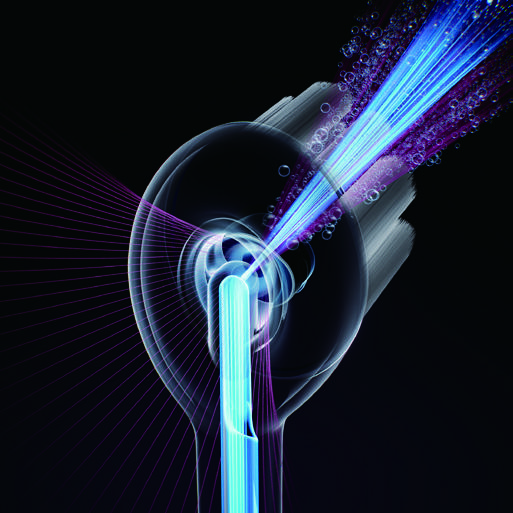
Compressed air is conducted through a hollow output shaft to a secondary boost chamber within the brush head assembly. This chamber further elevates air pressure to the cavitation threshold, generating microbubbles — gas cavities measuring on the order of microns to tens of microns in diameter — within the oral fluid and toothpaste foam matrix.
Cavitation as a cleaning mechanism is well-established in industrial and dental-hygiene contexts. Ultrasonic scalers, for instance, employ acoustic cavitation to disrupt calculus (Walmsley et al., 1988). The AirJet approach differs in that cavitation is generated pneumatically rather than acoustically, and the bubble population is delivered directionally through a controlled-flow geometry rather than omnidirectionally from a vibrating tip.
2.3 Coanda-Effect Flow Guidance
The brush head internal geometry is contoured to exploit the Coanda effect — the tendency of a fluid jet to attach to and follow a convex surface. As the pressurized air-microbubble stream traverses this curved channel, the resulting low-pressure boundary layer entrains surrounding oral fluid and dentifrice foam, increasing both the mass flow rate and the particulate density of the exiting plume.
This fluid-entrainment mechanism effectively amplifies the cleaning stream beyond what the pump alone would deliver, while the curved trajectory directs the flow toward interproximal spaces and the gingival sulcus — regions where mechanical bristle access is anatomically limited.
2.4 Vortex Dynamics and Interdental Transport
RANVOO invokes the reverse Kármán vortex street as a conceptual model for interdental fluid transport. In classic fluid dynamics, a Kármán vortex street describes the alternating vortex shedding pattern downstream of a bluff body. The reverse configuration — where vortices generate forward thrust rather than drag — is observed in aquatic propulsion, notably in the caudal fin kinematics of lamnid sharks (Triantafyllou et al., 2000).
By modulating brush-head sweep frequency and angular amplitude, the AirJet system is designed to generate forward-propagating oral fluid currents that carry cavitation microbubbles into interdental spaces. The engineering analogy is evocative, though publicly available computational fluid dynamics (CFD) simulations or particle-image velocimetry (PIV) data that would quantitatively validate this mechanism have not been released.
3. Performance Data and Critical Assessment
3.1 Reported Comparative Metrics
RANVOO’s internal laboratory reports the following comparative outcomes for the AirJet system versus conventional electric toothbrushes:
| Metric | Reported Value | Interpretation Notes |
|---|---|---|
| Plaque removal rate | 97% | Comparator model, protocol, and scoring index not publicly specified. |
| Working frequency | 39% lower | Absolute frequency values and measurement methodology not disclosed. |
| Physical applied force | 56% lower | Force sensor type, measurement location, and loading condition undefined. |
| Composite gum-damage rate | 90% lower (≤1/10 of conventional) | Composite index composition and scoring rubric not published. |
3.2 Third-Party Validation
The PH5 (X5) and PH3 (X3) models hold a CVC Cleaning Effect Classification Level 1 certificate (No. CVC24300012089, valid through February 19, 2029). This certification independently confirms cleaning efficiency at the highest classification tier under CVC’s testing protocol. It does not, however, independently verify each percentage figure in RANVOO’s comparative marketing claims, nor does it address gum-damage or applied-force metrics.
3.3 Frequency-Damage Relationship
RANVOO articulates a three-zone frequency-damage model based on its internal research:
- Zone I (<25,000 movements/min): Gum-damage increase described as relatively limited.
- Zone II (25,000–38,000 movements/min): Damage described as increasing noticeably with intensity.
- Zone III (>38,000 movements/min): Marginal cleaning improvement; sharply elevated damage risk.
This model is conceptually consistent with the broader dental literature on brushing force and gingival trauma, though the specific threshold values and damage quantification methods have not been subjected to independent peer review. The absence of published sample sizes, confidence intervals, and comparator product identities limits the evidentiary weight that can be assigned to these thresholds.
4. Product Implementation: The AirJet X5
4.1 Design and Specifications
The X5 (model code PH5) serves as the technology’s flagship deployment. Key specifications include:
| Parameter | Value |
|---|---|
| Dimensions | 250.8 × 34.4 × 30.4 mm |
| Mass | 152 g |
| Power input | 5 V / 0.8 A |
| Rated power | 4 W |
| Battery capacity | 1,600 mAh / 5.92 Wh |
| Battery life | 30 days (strong mode); 50 days (gentle mode) |
| Water resistance | IPX7 |
| Display | Full-screen dynamic |
| Sweep angle | 12° micro-sweep |
4.2 Bristle System
The brush head employs DuPont Pro-grade diamond filaments with a specified tip diameter of 0.01 mm and a 99.9% taper rate. Ultra-fine tapered bristles have been associated in the literature with improved subgingival access and reduced soft-tissue trauma compared to blunt-ended filaments (Checchi et al., 2001). The fully elastomer-wrapped brush-head base provides additional mechanical decoupling between the oscillating head and oral soft tissues.
Three interchangeable head variants extend functional range: Soft Gum-Care, Balanced Multi-Effect, and Diamond Whitening — each presumably optimized for different plaque and stain profiles, though detailed comparative performance data across head types have not been published.
4.3 User Interface and Modes
Five operational states are available: AirJet (maximum cavitation), Gentle (reduced intensity), Clean (balanced daily profile), Whiten (sustained jet-assisted surface treatment), and Travel Lock. Mode selection and system status are communicated via an integrated full-screen dynamic display — an interface choice that differentiates the X5 from the single-LED indicators prevalent in the category.
The magnetic wall-mounted charging dock addresses a practical compliance factor: evidence suggests that storage convenience and aesthetic integration influence long-term adherence to oral hygiene regimens (Asadoorian & Locker, 2006).
5. Research Gaps and Recommendations
Several areas would benefit from further investigation:
- Independent replication: The core performance claims — particularly the 97% plaque-removal rate and 90% gum-damage reduction — require replication by laboratories unaffiliated with the manufacturer, using pre-registered protocols and clearly identified comparator products.
- Longitudinal clinical data: Short-term plaque-removal studies, while informative, do not capture the cumulative effects of daily use on gingival health indices, attachment levels, or hard-tissue outcomes over months to years.
- CFD and flow-visualization data: Public release of computational fluid dynamics models or experimental flow-visualization (e.g., PIV or Schlieren imaging) would substantiate the Coanda-effect and reverse Kármán vortex claims.
- Cavitation characterization: Measurements of bubble size distribution, collapse pressure amplitudes, and spatial distribution within the oral cavity would strengthen the mechanistic narrative.
- Comparative effectiveness across populations: Efficacy and comfort outcomes should be assessed across relevant subgroups — including users with gingivitis, periodontitis, orthodontic appliances, and dental implants — where the risk-benefit calculus of conventional electric brushing is most contested.
6. Conclusion
RANVOO AirJet technology represents a conceptually coherent attempt to decouple oral cleaning efficacy from mechanical bristle aggression by substituting cavitation-microbubble dynamics for direct friction. The miniaturization of a multi-stage pneumatic system into a handheld form factor is an engineering achievement worthy of note. The internal performance data, if independently reproduced, would position the platform as a meaningful alternative for the substantial population of users who cannot tolerate — or should avoid — high-frequency mechanical brushing.
The current evidence base, centered on manufacturer-reported laboratory comparisons and a single third-party cleaning-efficiency certification, provides encouraging but incomplete support. Well-designed independent studies with transparent protocols, longitudinal endpoints, and clinically relevant comparator arms would significantly strengthen the scientific foundation for this technology.
For clinicians and consumers evaluating the AirJet X5, the available evidence suggests a device that is thoughtfully engineered, mechanistically distinct from the prevailing paradigm, and accompanied by performance claims that are internally consistent but await broader validation. In an oral-care landscape where incremental iteration has long substituted for fundamental innovation, AirJet’s willingness to challenge first principles warrants serious attention — and rigorous further study.
References (Selected)
- Addy, M., & Hunter, M. L. (2003). Can tooth brushing damage your health? British Dental Journal, 195(5), 249–253.
- Asadoorian, J., & Locker, D. (2006). The impact of oral health on quality of life. Journal of the Canadian Dental Association, 72(5), 435–440.
- Checchi, L., et al. (2001). Toothbrush bristle configuration and gingival abrasion. Journal of Clinical Periodontology, 28(7), 642–647.
- Heasman, P. A., et al. (2015). Gingival recession and toothbrush abrasion. Dental Update, 42(3), 250–256.
- Sicilia, A., et al. (2002). Powered toothbrushing and gingival recession. Journal of Clinical Periodontology, 29(3), 203–208.
- Triantafyllou, M. S., et al. (2000). Hydrodynamics of fishlike swimming. Annual Review of Fluid Mechanics, 32, 33–53.
- Walmsley, A. D., et al. (1988). Ultrasound in dentistry. Journal of Dentistry, 16(4), 146–153.
- Warren, P. R., et al. (2001). Powered toothbrushes: a review of clinical evidence. International Dental Journal, 51(2), 79–85.
Disclosure: Performance data cited from RANVOO internal laboratory reports. CVC certificate No. CVC24300012089, valid through February 2029. References are illustrative and should be independently verified before citation. This review does not constitute clinical guidance.

