


 DOI : 10.17577/
In many industries, we work with particles. Sand, coal, grains, rocks, and powders are everywhere. Understanding how these particles move, collide, and interact with fluids is very important. The Discrete Element Method (DEM) is a numerical technique that tracks every single particle. It calculates forces, collisions, and motion for each one. When we combine DEM with Computational Fluid Dynamics (CFD), we get a powerful tool called CFD-DEM coupling. This method simulates both the fluid flow and the particle dynamics at the same time. To learn how this works in practice, you can explore our DEM CFD Simulation tutorials.
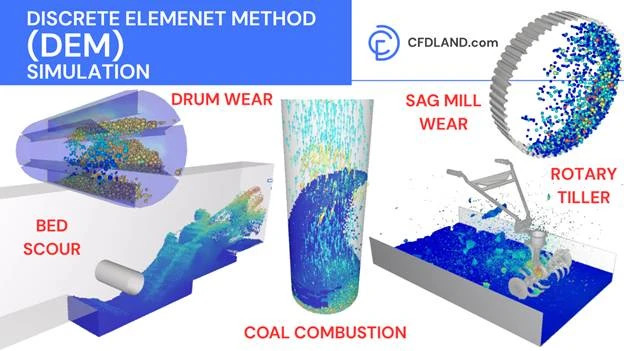
Figure 1: Examples of DEM and CFD-DEM simulations: bed scour, drum wear, coal combustion, SAG mill, and rotary tiller.
How DEM Works
The Discrete Element Method treats every particle as a separate object. It uses Newton’s second law to calculate the movement of each particle. When two particles touch, the software calculates the contact force using the Hertz-Mindlin contact model. This model considers the size, stiffness, and friction of each particle. DEM also calculates gravity, drag force, and other body forces. This makes it ideal for granular flow simulation and bulk material simulation in mining, agriculture, and chemical processing.
CFD-DEM Coupling: Fluid Meets Particles
Many real-world problems involve both fluids and particles together. This is where CFD-DEM coupling becomes essential. The CFD solver (like ANSYS Fluent) calculates the fluid velocity and pressure. The DEM solver (like Rocky DEM) calculates the particle positions and collisions. They exchange data every time step. The fluid pushes the particles (drag), and the particles push back on the fluid (momentum exchange). This is called two-way coupling and it captures particle-fluid interaction accurately.
Examples from Our Tutorials:
- Coal Combustion in Fluidized Bed Reactor: Hot air flows upward and suspends coal particles. The Fluent-Rocky coupling tracks combustion, heat transfer, and particle motion simultaneously. This is a complete CFD-DEM analysis of a fluidized bed simulation.
- Bed Scour Simulation: Water flows around a pipe on the seabed. Particles (sand) erode and move due to fluid forces. This shows particle-fluid interaction clearly.
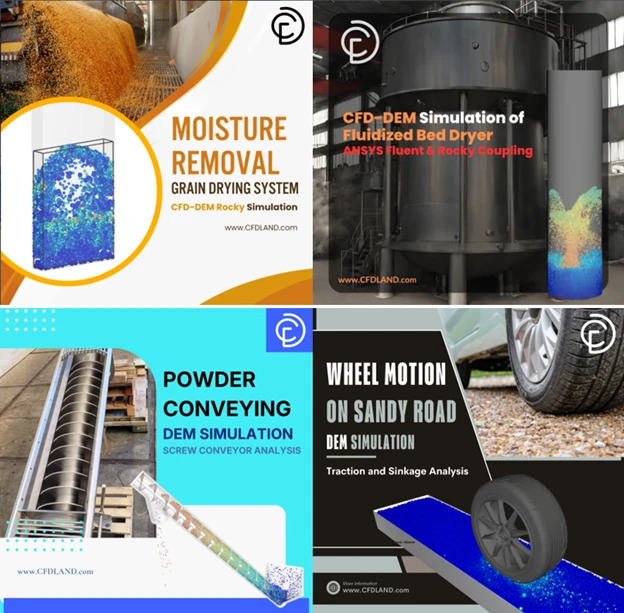
- Moisture Removal by Grain Drying: Hot air passes through wet grains. The simulation predicts how fast the grains dry using CFD-DEM Rocky simulation.
- Three-Phase Mixing Tank: Liquid, gas bubbles, and solid particles interact inside a tank. This uses the DDPM-DEM model in ANSYS Fluent.
- SAG Mill Wear Simulation: Rocks tumble inside a rotating mill. DEM predicts particle wear on the drum walls.
- Rotary Tiller: Blades cut through soil. DEM models the soil-tool interaction and predicts forces on the machine.
- Drum Wear Simulation: Particles rotate inside a cylinder. The simulation predicts equipment damage over time.
Conclusion
DEM simulation and CFD-DEM coupling help engineers solve problems in mining, agriculture, energy, and chemical engineering. By using Rocky DEM coupled with ANSYS Fluent, you can predict how particles behave in any system. Whether it is a fluidized bed reactor, a SAG mill, or a grain drying process, simulation saves time and money. Visit our website for more information about the world of CFD and DEM: CFDLAND.com
Our experts are ready to handle your CFD-DEM project and train you based on your need.

