


 DOI : 10.17577/
Abstract
Air knife systems powered by centrifugal blowers have become a widely adopted solution for drying, blowoff, and surface preparation across industrial manufacturing environments. This review examines the core operating principles of blower-driven air knife technology, compares performance characteristics against compressed air alternatives, and documents outcomes across key application areas including automotive component drying, food and beverage processing, pharmaceutical manufacturing, and wire and cable production. Documented case outcomes indicate significant reductions in energy consumption and downstream process improvements when blower-powered systems are correctly specified for the application.
- Introduction
Industrial manufacturing processes frequently require controlled removal of surface moisture, particulate contamination, or residual process fluids from parts, substrates, or packaging at production line speed. Historically, compressed air delivered through nozzles or open pipes served as the primary blowoff mechanism. While effective, compressed air blowoff systems carry substantial energy costs and deliver inconsistent coverage across complex part geometries.
Blower-powered air knife systems address these limitations by generating high-volume, low-pressure airflow through a centrifugal blower and delivering it as a focused, laminar air curtain through a precision-machined air knife. The result is controlled, consistent airflow across the full width of a product or conveyor at significantly lower energy input per unit of airflow delivered.
This review examines the engineering basis for this performance advantage, summarizes the key design variables governing system specification, and presents documented performance outcomes from automotive and industrial applications.
- Operating Principles
2.1 System Architecture
A complete blower-powered air knife system consists of three primary components: the centrifugal blower, the air distribution ducting, and the air knife itself. The centrifugal blower draws ambient air through an inlet filter assembly and accelerates it via an impeller, delivering pressurized airflow typically in the range of 1 to 4 PSIG at volumes between 100 and 3,500 CFM depending on blower model and motor configuration.
The air knife converts this volumetric airflow into a high-velocity sheet of air through a precision slot opening, typically 0.040 to 0.060 inches in width. Exit velocities at the knife face can reach 15,000 to 25,000 feet per minute, generating sufficient momentum to displace surface moisture or particulate at conveyor speeds up to 5,000 FPM.
2.2 Energy Efficiency
The energy efficiency advantage of blower-powered systems relative to compressed air is substantial. Compressed air generation typically requires 7 to 8 horsepower of input energy per horsepower of useful blowoff work delivered. Centrifugal blower systems, operating at low pressure, deliver equivalent blowoff performance at a fraction of this input energy. In documented industrial comparisons, blower-powered air knife systems have demonstrated energy savings of up to 14 times relative to compressed air systems performing equivalent drying or blowoff functions.
For high-volume manufacturing facilities operating multiple shifts, this differential translates directly into measurable utility cost reduction on an annual basis.
2.3 System Specification Variables
Correct specification of a blower-powered air knife system requires evaluation of the following parameters:
- Required air volume (CFM) based on product width, conveyor speed, and moisture load
- Operating pressure (PSIG) appropriate to the blowoff force required
- Air knife length and slot configuration for full coverage of the product profile
- Air temperature requirements, with heated air options available for accelerated evaporation applications
- Filtration requirements, with HEPA filtration available for pharmaceutical and cleanroom environments
- Application Areas and Performance Outcomes
3.1 Automotive Component Manufacturing
Pre-paint surface preparation represents one of the most demanding automotive applications for air knife drying technology. Parts exiting aqueous wash and rinse stages carry residual moisture in recesses, threaded features, and complex geometrical surfaces. Incomplete drying at this stage results in paint adhesion failures, coating defects, and increased reject rates.
In one documented application, a Japanese automotive component manufacturer processing bumper parts prior to painting implemented an air knife system incorporating XE-series air knives, swivel-mounted air nozzles, and manifolds configured to the specific part geometry. The system achieved removal of over 95% of rinse water from all part surfaces before parts entered the pre-paint heating tunnel. As a result, the customer reduced pre-paint oven heating capacity by more than 50%, with concurrent reductions in paint reject rates and improvements in overall paint line efficiency.
Blower-powered air knife systems also serve automotive quality assurance processes. In shower testing and leak verification procedures, vehicle exteriors and subassemblies require rapid water removal after pressure spray testing before advancing to subsequent inspection or assembly stations. A Japanese bus manufacturer deployed 25HP blower-powered industrial air knife systems to dry four bus models ranging from 9 meters to 18 meters in length following leak testing. The installation met JISHA noise compliance requirements of less than 80 dBA, demonstrating that high-performance blowoff systems can operate within industrial noise regulation standards.
3.2 Food and Beverage Processing
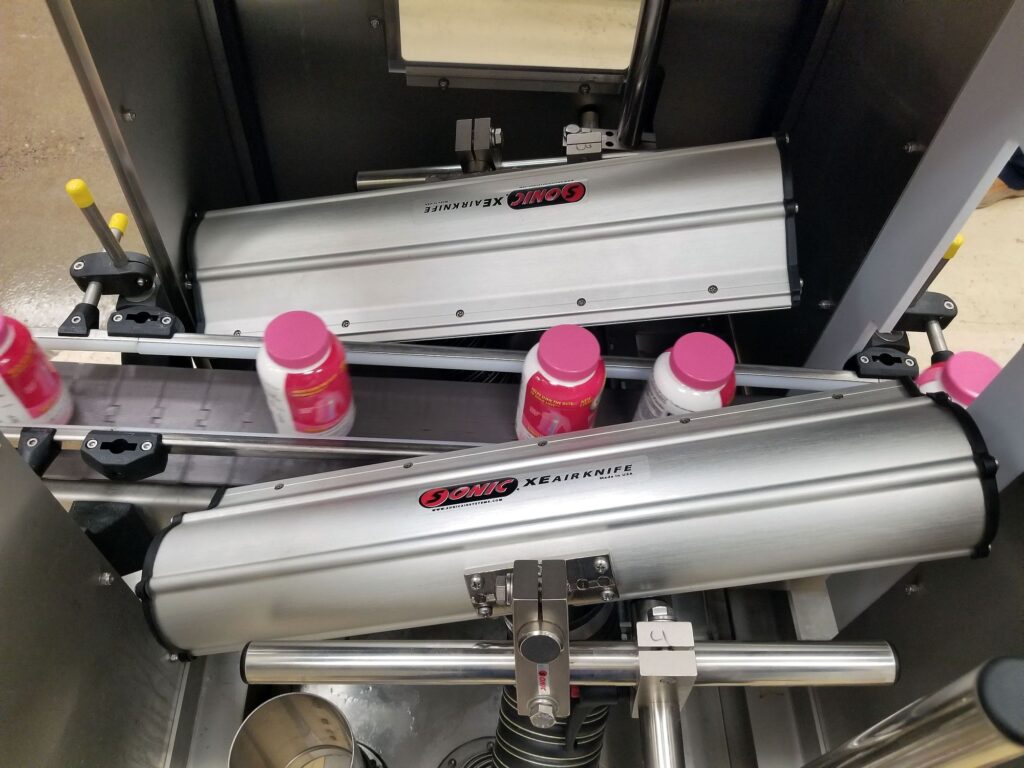
Beverage container drying between washing and labeling or coding operations is a standard air knife application in food and beverage manufacturing. Residual surface moisture at the labeling stage causes label adhesion failure and date code legibility problems. Air knife drying systems are positioned at the exit of washing or pasteurization tunnels to deliver complete surface drying at line speed without interrupting throughput.
Sanitary air knife designs constructed from stainless steel with smooth, cleanable surfaces are available for direct food contact applications, meeting applicable food safety standards for hygienic equipment design.
3.3 Pharmaceutical and Medical Device Manufacturing
Pharmaceutical and medical device production environments impose requirements beyond standard industrial applications, including controlled particulate levels and documented process validation. Air knife systems integrated with inline HEPA filtration deliver clean, filtered drying air to sensitive components and packaging, eliminating the risk of particulate redeposition during the drying process.
The consistent, controllable nature of blower-powered airflow supports process documentation requirements, as system operating parameters including pressure, flow rate, and air temperature can be monitored and recorded.
3.4 Wire and Cable Production
Continuous extrusion and cooling processes in wire and cable manufacturing require immediate drying of cable jackets as they exit water cooling troughs before spooling or subsequent processing. Air knife systems configured as air wipes, with the cable passing through a circular airflow aperture, deliver complete circumferential drying at line speed across a range of cable diameters. Systems are available to accommodate product sizes from 1 inch to 100 inches in width or diameter.
- Discussion
The performance outcomes documented across these application areas reflect consistent themes: blower-powered air knife systems deliver measurable improvements in energy efficiency, process consistency, and downstream quality metrics when specified correctly for the application. The 50% reduction in pre-paint oven capacity documented in the automotive component case represents a particularly significant outcome, demonstrating that effective drying at an upstream process stage can reduce thermal energy demand in subsequent stages.
The principal engineering consideration in system deployment is correct specification of airflow volume and pressure relative to the process requirements. Undersized systems produce incomplete drying; oversized systems consume unnecessary energy. Supplier application engineering support, including physical sample testing prior to system specification, provides validation of system performance before installation.
- Conclusion
Blower-powered air knife systems offer a technically and economically superior alternative to compressed air blowoff across the majority of industrial drying and surface preparation applications. Energy savings of 7 to 14 times relative to compressed air, combined with documented improvements in process quality and downstream efficiency, support adoption across automotive, food and beverage, pharmaceutical, and wire and cable manufacturing environments. For engineers evaluating drying and blowoff system options, industrial air knife systems represent a well-established solution with a documented performance record across diverse manufacturing applications.
References
[1] Sonic Air Systems. Automotive Drying Solutions: Paint Line Performance Case Study. Brea, CA: Sonic Air Systems, 2024. [2] Sonic Air Systems. Industrial Air Knife Systems Support Japanese Bus Manufacturer Quality Assurance. Brea, CA: Sonic Air Systems, 2021.
